
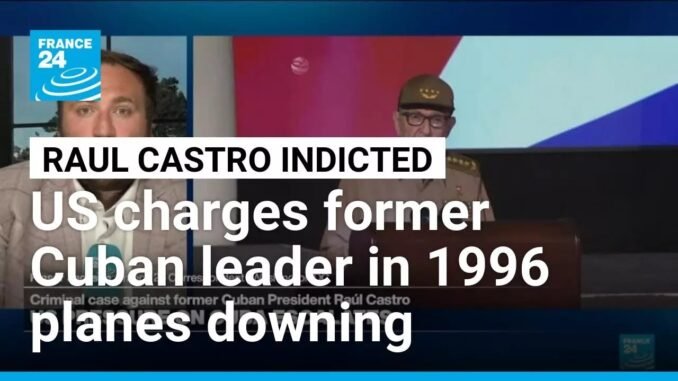

Summary: The United States has indicted ex-Cuban President Raúl Castro and five others for the 1996 shooting down of civilian aircraft that killed four people, reviving a 29-year-old international incident.
In a dramatic legal move that has sent shockwaves through international diplomatic circles, the United States government has unsealed criminal charges against Raúl Castro, Cuba’s former president, and five other Cuban officials. The indictment relates to a tragic incident that occurred nearly three decades ago—the shooting down of two civilian aircraft over international waters in 1996.
The Incident That Sparked International Outrage
On February 24, 1996, Cuban military jets shot down two small planes operated by Brothers to the Rescue, a Miami-based humanitarian organization. The group was known for flying search-and-rescue missions to locate Cuban refugees attempting to cross the Florida Straits in makeshift boats—a perilous journey many Nigerians can relate to, given the dangerous migration routes some of our compatriots have undertaken in search of better opportunities abroad.
The attack resulted in the deaths of four men: three American citizens and one legal U.S. resident. The planes were flying over international waters at the time, making the incident a clear violation of international law and an act that many described as state-sponsored murder.
Who Is Raúl Castro?
For those unfamiliar with Cuban politics, Raúl Castro is the younger brother of the late revolutionary leader Fidel Castro. He served as Cuba’s president from 2008 to 2018 and was a key figure in the Cuban military and government for over six decades. At the time of the 1996 incident, Raúl Castro was serving as Cuba’s Minister of Defense, giving him direct oversight of the military operations that led to the downing of the aircraft.
Now 93 years old, Castro has largely withdrawn from public life, but this indictment brings his controversial legacy back into the international spotlight.
The Legal Charges
The unsealed indictment charges Castro and his co-defendants with several serious crimes, including:
– Murder of U.S. nationals
– Conspiracy to commit murder
– Destruction of aircraft resulting in death
– Aircraft piracy
These are not minor accusations. If convicted, the defendants could face life imprisonment or even the death penalty under U.S. federal law.
Why Now? The Timing Question
Many observers are asking: why has the United States chosen to unseal this indictment nearly 29 years after the incident occurred?
The timing appears connected to broader shifts in U.S.-Cuba relations. After a brief warming of ties during the Obama administration, relations between Washington and Havana have remained frosty. The indictment sends a strong political message that the U.S. has not forgotten—and will not forgive—what it considers acts of international terrorism by the Cuban government.
For Nigeria and other African nations that value sovereignty and non-interference, this case raises important questions about international justice, extradition, and how historical grievances are pursued across borders.
The Nigerian Perspective: Lessons in International Relations
This development offers several lessons relevant to Nigeria’s own complex international relationships:
1. Justice Delayed, Not Denied: The case demonstrates that serious international crimes can be prosecuted decades later. This has implications for ongoing efforts to hold perpetrators of human rights abuses accountable in various parts of the world, including Africa.
2. Sovereignty vs. Accountability: Cuba will almost certainly refuse to hand over Castro or any of the other indicted officials. This highlights the tension between national sovereignty and international criminal accountability—an issue Nigeria has grappled with regarding the International Criminal Court.
3. Diplomatic Weapons: Criminal indictments have become tools of foreign policy. Understanding this helps Nigerian policymakers navigate our own complex relationships with Western powers and other nations.
What Happens Next?
Practically speaking, the likelihood of Raúl Castro ever standing trial in a U.S. court is virtually zero. Cuba does not have an extradition treaty with the United States, and the Cuban government has already dismissed the charges as politically motivated.
However, the indictment has real consequences:
– Travel Restrictions: The indicted individuals cannot travel to countries with U.S. extradition treaties without risk of arrest
– Asset Freezes: Any assets they hold in U.S. jurisdiction or allied countries could be seized
– Historical Record: The indictment officially establishes the U.S. government’s position on who was responsible for the deaths
– Family Impact: Relatives of the victims, who have waited nearly three decades for this moment, finally see formal recognition of their loss
International Reactions
The international community remains divided on this issue. U.S. allies have generally supported the move, viewing it as a necessary step toward justice. However, Cuba and its allies, including several Latin American nations, have condemned the indictment as a continuation of U.S. aggression against the island nation.
For neutral observers in countries like Nigeria, the incident serves as a reminder of how Cold War-era conflicts continue to cast long shadows over contemporary international relations.
The Broader Context of U.S.-Cuba Relations
The 1996 shootdown was a defining moment in U.S.-Cuba relations. It led to the strengthening of the U.S. embargo against Cuba through the Helms-Burton Act and effectively froze any progress toward normalization for years.
Even today, decades after the Cold War ended, the relationship between these two neighbors remains one of mutual suspicion and hostility. This persistence of historical grievances mirrors situations in various parts of the world, including some of Nigeria’s own regional challenges.
Conclusion: A Case Study in Long-Term Accountability
The indictment of Raúl Castro and his associates reminds us that in international affairs, the wheels of justice may turn slowly, but they continue to turn. Whether this legal action brings genuine closure to the families of the victims or simply serves as another chapter in a decades-long political conflict remains to be seen.
For Nigerian readers following international affairs, this case offers valuable insights into how major powers pursue accountability across borders and how smaller nations navigate pressure from global superpowers. It’s a reminder that in the complex world of international relations, yesterday’s actions can have consequences that echo for generations.
As we watch this legal drama unfold, one thing is certain: the pursuit of justice, whether genuine or politically motivated, knows no statute of limitations in the arena of international law.
Stay tuned for more details on buzzUp9ja
Be the first to comment