
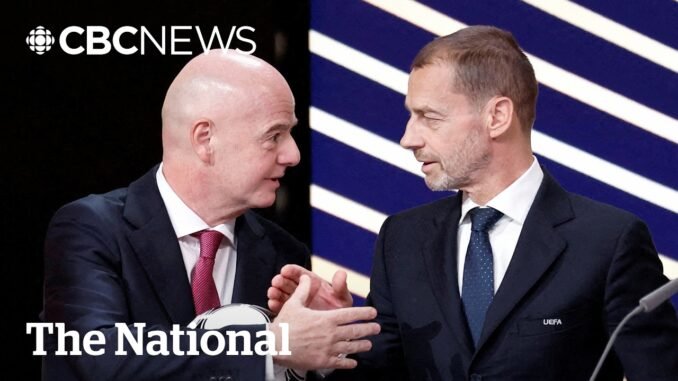

Summary: UEFA nations are threatening a full boycott of FIFA competitions over plans to sell World Cup broadcasting rights to US private investors. Here’s what this means for African football and Nigeria specifically.
—
The football world is sitting on a keg of gunpowder right now, and the fuse is being lit from the top floors of FIFA’s Zurich headquarters.
European nations have reportedly reached a unanimous agreement — they will boycott all FIFA competitions if president Gianni Infantino goes ahead with his controversial plan to sell portions of the FIFA World Cup to US-based private investment firms. Yes, you read that correctly. The same tournament that stops Lagos traffic every four years, the same competition that turns Nigerian offices into ghost towns during matchday — that World Cup — is at the centre of a massive power struggle.
—
What Is Infantino Actually Trying to Do?
In simple terms, FIFA’s president wants to bring in American private equity money by selling a significant stake in World Cup broadcasting and commercial rights. Think of it like Dangote selling shares in his refinery — except in this case, the “refinery” is the most-watched sporting event on the planet, and many football stakeholders were never consulted before the deal was put on the table.
UEFA, the governing body for European football, is not having any of it. European football associations have closed ranks and are threatening to pull their nations out of all FIFA-organised competitions if these plans move forward without proper consultation and agreement.
—
Why Are the Europeans So Angry?
For the Europeans, this isn’t just about money — though money is certainly at the heart of it. Their concerns include:
– Loss of control: Handing commercial rights to private American investors could fundamentally change how the World Cup is run and who benefits from it
– Transparency issues: Many federations feel the process has been secretive and rushed
– Governance concerns: Football’s governing structures are built on the idea that member associations have a say in major decisions — not just the man at the top
UEFA president Aleksander Čeferin has been particularly vocal, warning that European nations will not stand by and watch FIFA become a vehicle for profit extraction by Wall Street-type investors.
—
So What Does This Mean for Nigeria and Africa?
Now, here is where we Nigerians need to pay very close attention, because this is not just oyibo people’s wahala.
If European nations boycott the World Cup, the tournament loses its biggest draw — countries like England, France, Germany, Spain, Portugal, and the rest. Imagine a World Cup without those nations. The viewership numbers would collapse. Sponsorship deals would dry up. The billions of dollars that FIFA redistributes to member associations — including CAF members like Nigeria — would shrink dramatically.
The Super Eagles’ qualification campaigns, the prize money Nigeria earns from World Cup participation, the development funds that trickle down to grassroots football in Nigeria — all of these are tied to the financial health of the FIFA World Cup.
Beyond the money, there is also the principle of governance. African football federations have long complained about being sidelined in major FIFA decisions. If even the powerful Europeans are being steamrolled, you can imagine where that leaves CAF nations.
—
The Bigger Picture: Who Really Controls Football?
This whole saga is a reminder that world football remains a deeply political space. Infantino, who has been cosying up to African leaders and presenting himself as a champion of Global South football, now finds himself at war with the continent that produces the majority of the world’s top players and the bulk of commercial revenue.
The irony is not lost on many football observers — the man who promised to give more to Africa and Asia may end up presiding over a fractured FIFA that gives less to everyone.
—
What Happens Next?
All eyes are now on the next FIFA Congress and Council meetings, where this battle is expected to reach boiling point. Infantino will need to either:
1. Back down and abandon or significantly modify his investment proposals
2. Push forward and risk the most damaging split in world football since the Super League fiasco
Either way, Nigerian football fans, administrators, and stakeholders should be watching this space very closely. The outcome will shape the future of the World Cup — and with it, the future of football on the African continent.
—
One thing is certain — football is never just a game. Sometimes, it is big politics, big money, and very big consequences. And Nigeria, as always, is right in the middle of the story whether we are paying attention or not.
Check for more news on buzzUp9ja
Be the first to comment