
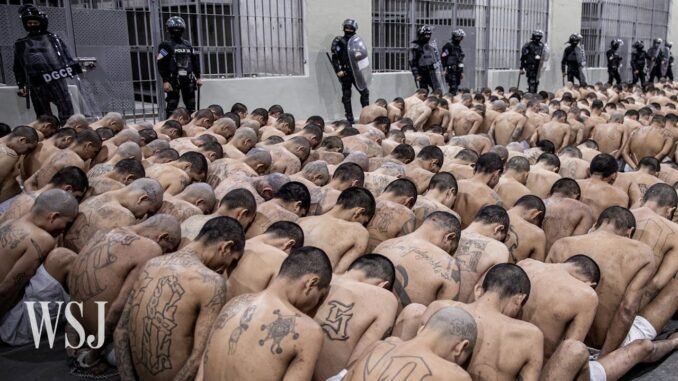

Summary: El Salvador conducts one of the world’s largest gang trials as nearly 500 MS-13 members face charges for thousands of murders. See how this historic prosecution unfolds.
In a dramatic display of judicial power, El Salvador has commenced what may be one of the largest criminal trials in modern history. Nearly 490 alleged members of the notorious Mara Salvatrucha gang, better known as MS-13, appeared in court on Monday, April 20, facing charges connected to approximately 29,000 murders.
The mass trial, which includes several suspected high-ranking leaders of the feared Central American gang, represents a bold move by the Salvadoran government to tackle organized crime that has plagued the nation for decades.
Understanding MS-13: A Global Criminal Network
For Nigerians unfamiliar with MS-13, think of it as similar to some of the most dangerous cult groups and organized criminal gangs that have operated in various parts of our country. MS-13, however, operates on an international scale, with tentacles reaching across Central America, Mexico, and even into the United States.
The gang is notorious for extreme violence, drug trafficking, extortion, and territorial control—activities that have destabilized entire communities across El Salvador and beyond.
A Bold Approach to Justice
The decision to try nearly 500 defendants simultaneously is unprecedented in scale. El Salvador’s government, under President Nayib Bukele, has taken an increasingly hardline stance against gang violence, implementing what they call a “war on gangs.”
This approach mirrors discussions we’ve had in Nigeria about how to deal with criminal organizations, cultism, and banditry. The question always remains: what is the most effective way to restore law and order while maintaining justice?
The Charges: A Staggering Death Toll
The 29,000 murders allegedly connected to these defendants represent decades of terror inflicted on Salvadoran communities. To put this in perspective, this figure exceeds the population of many Nigerian local government areas.
Each charge represents a family torn apart, a community traumatized, and a life cut short by senseless violence—a reality that resonates deeply with Nigerians who have experienced various forms of violent crime and insurgency in different parts of our nation.
The Trial Process
Conducting a trial of this magnitude presents enormous logistical challenges:
– Security concerns: Moving and housing nearly 500 high-risk defendants
– Legal representation: Ensuring each defendant receives adequate legal counsel
– Evidence management: Presenting and examining evidence for thousands of individual crimes
– Witness protection: Safeguarding those brave enough to testify
These challenges are familiar to Nigerian law enforcement and judicial authorities who have dealt with mass prosecutions of Boko Haram suspects, bandits, and members of various criminal gangs.
What This Means for El Salvador
For ordinary Salvadorans, this trial represents hope—hope that the streets might become safer, that businesses can operate without paying extortion money, and that children can grow up without being recruited into gangs.
However, critics worry about potential human rights violations and whether such mass trials can truly deliver individual justice.
Lessons for Nigeria
As Nigeria continues to grapple with its own security challenges—from banditry in the Northwest to cultism in the Southeast and insurgency in the Northeast—El Salvador’s approach offers important lessons:
1. Political Will Matters: Decisive government action can disrupt even the most entrenched criminal networks.
2. Justice Must Be Swift: Years of impunity embolden criminals; timely prosecution sends a strong message.
3. Community Support Is Essential: Without public backing, even the best security initiatives will fail.
4. Balance Is Key: Tough measures must be balanced with respect for human rights and due process.
The Road Ahead
As this historic trial proceeds, the world watches to see whether El Salvador’s aggressive approach will succeed in breaking the power of MS-13. The outcome could influence how other nations, including Nigeria, approach organized crime.
Will mass prosecutions prove effective, or will they create new problems while solving old ones? Only time will tell.
Final Thoughts
The images emerging from this mass trial are striking—hundreds of shaved-headed defendants in white prison uniforms, a visual representation of a government determined to restore order at any cost.
For Nigerians, this moment serves as a reminder that we are not alone in facing security challenges. Nations around the world struggle with how to balance justice, security, and human rights when confronting organized violence.
As we follow this unprecedented trial, we must ask ourselves: what can we learn from El Salvador’s experience? How can we apply these lessons to our own context while staying true to our values and constitutional principles?
The fight against organized crime is a marathon, not a sprint—and every nation must find its own path to lasting peace and security.
What are your thoughts on mass trials as a tool for fighting organized crime? Should Nigeria consider similar approaches for dealing with criminal gangs? Share your views in the comments below.
Visit buzzUp9ja for more details
Be the first to comment