
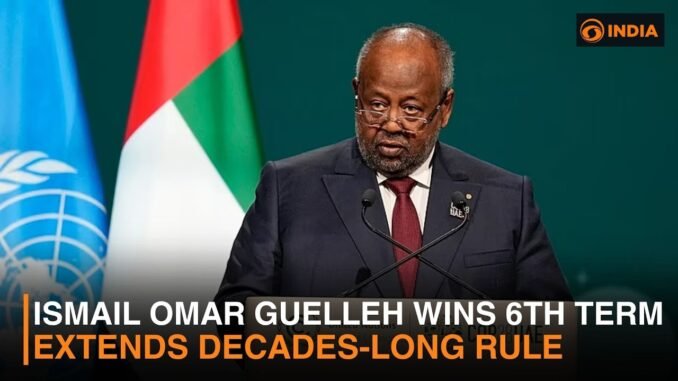

Djibouti’s veteran leader, President Ismail Omar Guelleh, has once again demonstrated his political dominance in the tiny Horn of Africa nation, securing a sixth consecutive term with a landslide victory of 97.8% in Friday’s presidential election.
The official results, announced over the weekend, confirm that the 77-year-old leader will continue his quarter-century grip on power in the strategically important country that sits at the crossroads of Africa and the Middle East.
A Political Dynasty Continues
Guelleh, who first assumed office in 1999, has now extended his rule over Djibouti, a country roughly the size of Ekiti State but with immense geopolitical significance. His latest electoral victory mirrors the pattern of previous elections, where opposition voices have remained largely marginalized.
The election results show an overwhelming mandate, though critics and international observers have consistently raised concerns about the democratic space in the country. Just as Nigerians are familiar with debates around electoral transparency and democratic consolidation, Djibouti’s political landscape remains a subject of international scrutiny.
Why Djibouti Matters Globally
Despite its small size—with a population of just about one million people—Djibouti punches well above its weight on the international stage. The country hosts military bases for several global powers, including the United States, France, China, and Japan, making it a crucial strategic hub for international security and commerce.
The nation’s location at the entrance to the Red Sea and the Bab el-Mandeb Strait makes it a vital shipping route for global trade, particularly for oil tankers heading to and from the Suez Canal. This strategic importance has made Djibouti’s stability a priority for major world powers.
Questions About Democratic Space
While President Guelleh maintains strong support among sections of the population, particularly for infrastructure development and maintaining stability in a volatile region, his administration has faced criticism over limited political freedoms and restrictions on opposition activities.
The near-unanimous vote share of 97.8% has raised eyebrows among democracy advocates, who argue that genuine competitive democracy requires robust opposition and open political space—principles that many African nations, including Nigeria, continue to grapple with as democratic institutions mature.
Economic Development Under Guelleh
To his credit, President Guelleh has overseen significant infrastructure development in Djibouti, including modern ports, railways, and free trade zones. The country has positioned itself as a regional logistics hub, attracting substantial foreign investment, particularly from China, which has transformed the capital city’s skyline.
These developments have created employment opportunities and improved connectivity with neighboring Ethiopia, which relies heavily on Djibouti’s ports for its import and export trade.
What This Means for the Region
Guelleh’s continued leadership ensures policy continuity in a region marked by instability. With conflicts in nearby Somalia, Yemen, and periodic tensions in Ethiopia and Eritrea, Djibouti’s stability has made it an anchor of relative peace in the Horn of Africa.
For Nigeria and other African nations watching, Djibouti represents both an example of stability and a reminder of ongoing conversations about term limits, democratic transitions, and the balance between development and democratic governance.
As President Guelleh begins his sixth term, the international community will be watching how Djibouti navigates the delicate balance between maintaining its strategic partnerships and addressing domestic calls for greater political inclusion and democratic reforms.
What are your thoughts on long-serving leaders in Africa? Should there be term limits for presidents? Share your views in the comments below.
Visit buzzUp9ja for more updates
Be the first to comment