
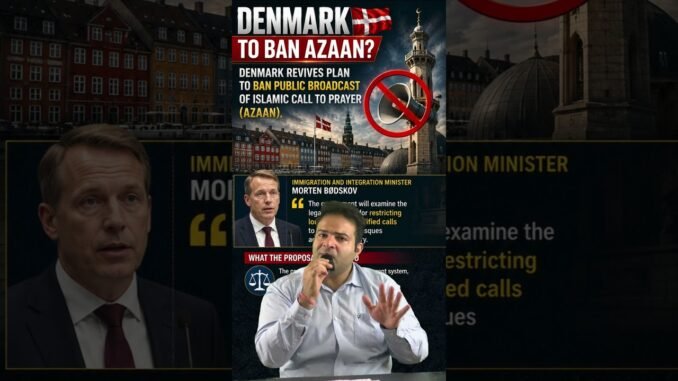

Summary: Denmark’s government announces plans to ban the Islamic call to prayer nationwide, citing cultural concerns. The controversial move has sparked intense debate across Europe and beyond.
—
Denmark has ignited a fierce debate across Europe and the Muslim world with its latest announcement: a comprehensive ban on the Islamic call to prayer, known as the Adhan, from being broadcast publicly across the country.
The Scandinavian nation’s Business Minister has taken a firm stance, declaring that the traditional Muslim call to worship has “no place” in Denmark, warning that allowing it would transform parts of the country into what he controversially described as “a suburb of Islamabad.”
What is the Islamic Call to Prayer?
For those unfamiliar, the Adhan is the melodious call that summons Muslims to their five daily prayers. Traditionally broadcast from mosque minarets through loudspeakers, it’s a fundamental part of Islamic tradition practiced for over 1,400 years. In Muslim-majority countries—including Northern Nigeria—the call resonates through communities at dawn, midday, afternoon, sunset, and night.
Denmark’s Controversial Position
This isn’t Denmark’s first attempt at such legislation. The predominantly Christian nation, which has seen increased Muslim immigration in recent decades, has previously explored similar restrictions. However, this latest push appears more determined and has gained significant political backing.
Danish authorities argue that the amplified call to prayer disrupts public peace and doesn’t align with the country’s cultural identity. They insist that Muslims can still practice their faith freely but must do so without external broadcasts that affect non-Muslim residents.
A Familiar Debate with Global Implications
Denmark’s move mirrors similar actions taken by other European countries grappling with multiculturalism and religious accommodation. Several nations, including parts of Germany, Austria, and Switzerland, have implemented various restrictions on mosque minarets and prayer calls.
For Nigerians, this debate may sound somewhat familiar yet distinctly different. In Nigeria, where religious diversity is constitutionally protected, the call to prayer coexists with church bells and other religious expressions—though not without occasional friction in mixed communities.
The Supporters’ Argument
Proponents of the ban argue that:
– Denmark has a right to preserve its cultural heritage and traditions
– Amplified religious broadcasts constitute noise pollution
– Religious freedom doesn’t extend to imposing sounds on non-believers
– Muslims can receive prayer reminders through modern technology like mobile apps
The Opposition’s Concerns
Critics, however, see this differently:
– It specifically targets one religion, raising discrimination concerns
– True religious freedom includes public expression, not just private worship
– The ban could fuel Islamophobia and marginalize Muslim communities
– It sets a concerning precedent for religious restrictions in democratic societies
What This Means for Religious Freedom
The Danish proposal raises fundamental questions about where religious liberty ends and communal rights begin. In a world increasingly connected yet divided, how do diverse societies balance respect for tradition with accommodation of minority practices?
For Nigeria’s religiously diverse population, where constitutional provisions protect both Christianity and Islam (alongside traditional religions), Denmark’s approach represents a stark contrast to our own complex but generally accommodative system.
The Path Forward
As Denmark moves forward with this legislation, the international community watches closely. The outcome could influence similar debates in other Western nations hosting significant Muslim populations.
Muslim organizations within Denmark have vowed to challenge any ban through legal channels, arguing it violates European human rights conventions protecting religious expression.
Final Thoughts
Whether you view Denmark’s decision as a necessary assertion of cultural identity or an unfortunate step toward intolerance likely depends on your perspective about multiculturalism, religious accommodation, and national sovereignty.
What remains clear is that as global migration continues reshaping demographics, these conversations about identity, tradition, and coexistence will only become more urgent—not just in Europe, but worldwide.
—
What’s your take on this development? Should countries have the right to restrict religious practices that affect public spaces, or does religious freedom require accommodating such traditions? Share your thoughts in the comments below.
Get more updates on buzzUp9ja
Be the first to comment