
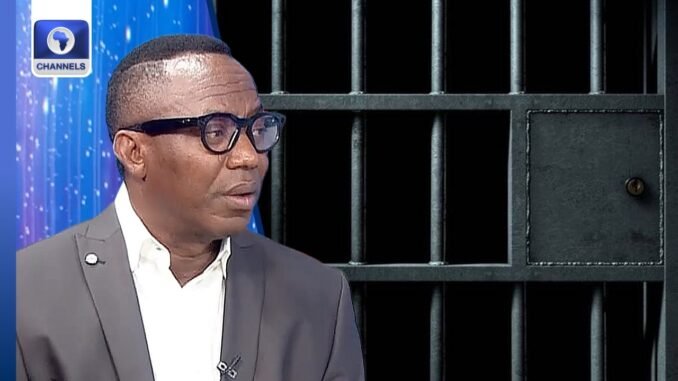

Human rights activist and former presidential candidate, Omoyele Sowore, has called on the Federal Government to take drastic action against corrupt public officials by demolishing their ill-gotten properties and seizing assets acquired with stolen public funds.
The publisher of Sahara Reporters made this bold demand while addressing the persistent corruption that has plagued Nigeria’s public sector for decades. Sowore argued that simply prosecuting corrupt officials is insufficient; the government must send a stronger message by physically destroying properties built with money meant for national development.
A New Approach to Fighting Corruption
“Public officials who steal public funds to build mansions and acquire vast assets should have their mansions demolished,” Sowore declared, emphasizing that such decisive action would serve as a deterrent to current and future public servants contemplating misappropriating state resources.
The activist’s proposal goes beyond the traditional approach of asset forfeiture, where confiscated properties are either sold or converted to government use. Instead, he advocates for the complete demolition of such structures as a visible symbol of the consequences of corruption.
The Context: Nigeria’s Corruption Challenge
Nigeria has consistently ranked poorly on global corruption perception indices, with public officials at various levels of government frequently accused of embezzling billions of naira meant for infrastructure, healthcare, education, and other critical sectors.
Despite the establishment of anti-corruption agencies like the Economic and Financial Crimes Commission (EFCC) and the Independent Corrupt Practices and Other Related Offences Commission (ICPC), many Nigerians feel that corruption remains largely unpunished, with convicted officials often receiving light sentences or successfully appealing their cases.
Mixed Reactions from Nigerians
Sowore’s proposal has generated considerable debate across social media platforms and within policy circles. Supporters argue that such drastic measures are necessary given the brazen nature of corruption in Nigeria, where public officials build palatial mansions in their villages while communities lack basic amenities like clean water, electricity, and functional schools.
Critics, however, question the legality and practicality of such an approach, raising concerns about due process, property rights, and the potential for abuse. Some legal experts have pointed out that while asset forfeiture is legally recognized, outright demolition of buildings may face constitutional challenges.
International Precedents
While Sowore’s proposal may sound extreme, some countries have taken similar tough stances against corruption-related properties. China, for instance, has demolished luxury villas built illegally by corrupt officials, while other nations have converted seized properties into public facilities or affordable housing.
The Broader Anti-Corruption Debate
Sowore’s call comes amid growing frustration among ordinary Nigerians who continue to bear the brunt of poor governance and corruption. With inflation soaring, unemployment high, and essential services collapsing, many citizens are demanding more aggressive action against those who have enriched themselves at public expense.
The activist has long been a vocal critic of corruption in Nigeria, consistently using his platform to expose alleged malfeasance and call for accountability. His latest demand adds to the ongoing national conversation about how Nigeria can effectively combat corruption and recover stolen wealth.
What This Means for Nigeria’s Future
Whether or not the Federal Government adopts Sowore’s proposal, his intervention highlights the urgent need for more effective anti-corruption strategies in Nigeria. As the country grapples with economic challenges and development deficits, the question of how to deal with corrupt officials and their ill-gotten wealth remains critical to national progress.
For now, the debate continues: Should Nigeria adopt more aggressive measures against corruption, even if they seem extreme? Or should the focus remain on strengthening existing legal frameworks and institutions?
What is clear is that ordinary Nigerians are tired of watching public officials live in obscene luxury while the majority struggles to survive. The pressure for accountability has never been higher, and activists like Sowore are ensuring that the conversation remains front and center in the national discourse.
Stay tuned for more on buzzUp9ja
Be the first to comment