
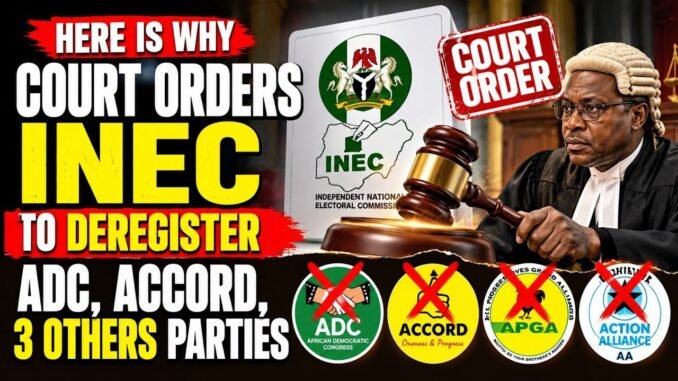

Summary: Peter Obi condemns Federal High Court ruling ordering deregistration of ADC, Accord, and three other Nigerian political parties. Read why he says the decision should be reversed and what it means for democracy.
Former Anambra State Governor and Labour Party’s 2023 presidential candidate, Peter Obi, has strongly opposed the recent Federal High Court ruling that ordered the deregistration of five political parties in Nigeria.
The controversial judgment, delivered by Justice Peter Odo Lifu of the Federal High Court in Abuja, directed the Independent National Electoral Commission (INEC) to remove the African Democratic Congress (ADC), Accord Party, and three other political parties from its register.
Peter Obi’s Strong Opposition
Taking to his social media platforms, the former presidential candidate expressed deep concern about the court’s decision, describing it as detrimental to Nigeria’s democratic progress. According to Obi, the ruling represents a significant setback for the multi-party system that Nigeria has worked hard to establish and maintain.
“This decision should be reversed,” Obi stated emphatically. “Democracy thrives on pluralism and the availability of credible alternatives for our people to choose from.”
Why This Ruling Matters for Nigerian Democracy
The deregistration of political parties has become a recurring issue in Nigeria’s political landscape. Many political analysts argue that reducing the number of registered parties could limit citizens’ choices during elections and potentially strengthen the dominance of established parties like the All Progressives Congress (APC) and the Peoples Democratic Party (PDP).
The affected parties—ADC and Accord—have significant political history in Nigeria. Accord Party particularly gained prominence in the Southwest region, while ADC has fielded candidates in various elections across multiple states.
The Legal Basis for Deregistration
INEC has constitutional powers to deregister political parties that fail to meet certain criteria, including:
– Winning at least 25% of votes in one state during gubernatorial elections
– Securing at least one seat in the National Assembly
– Maintaining functional offices across Nigeria
– Demonstrating consistent political activity
However, critics argue that these requirements often favor well-funded, established parties while making it extremely difficult for smaller parties to survive, even when they represent genuine political movements.
Growing Concerns About Democratic Space
Peter Obi’s objection reflects broader concerns among Nigerian civil society organizations, political activists, and democracy advocates about the shrinking space for political participation. Many fear that continuous deregistration of parties could eventually lead to a two-party system similar to what exists in some Western democracies, but without the institutional safeguards those systems possess.
“We cannot build a strong democracy by limiting options,” one political analyst noted. “What we need is to strengthen all parties and ensure they operate according to democratic principles.”
What Happens Next?
The affected parties have the constitutional right to appeal the Federal High Court’s judgment at the Court of Appeal. Legal experts expect that some, if not all, of the deregistered parties will pursue this option vigorously.
Meanwhile, Peter Obi’s intervention has added significant political weight to the controversy, potentially influencing public opinion and encouraging the affected parties to exhaust all legal remedies.
The Bigger Picture
This development comes at a time when Nigeria is preparing for the 2027 general elections. The political landscape is already heating up, with various realignments and discussions about possible coalitions among opposition parties.
For ordinary Nigerians, the question remains: does having more political parties truly translate to better democratic outcomes, or should the focus be on strengthening existing parties to become more accountable and responsive to citizens’ needs?
As this legal battle unfolds, one thing is clear—the conversation about the future of Nigeria’s multi-party democracy is far from over.
Stay updated for more on buzzUp9ja
Be the first to comment