
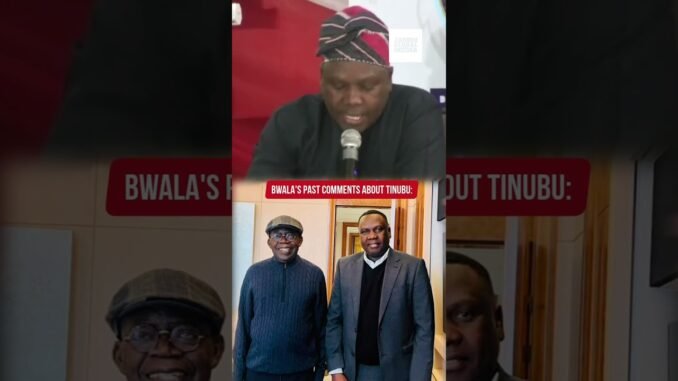

If you have been following Nigerian politics for any reasonable amount of time, you already know that the distance between opposition critic and government spokesman can sometimes be shorter than the Lagos-Ibadan Expressway. The latest person to walk that familiar path is Daniel Bwala — and he wants you to know that everything he said about Bola Tinubu before? Consider it expired.
Bwala, who now serves as Presidential spokesman, has come out to say that his past remarks against President Tinubu should no longer take up space in public conversation. According to him, those comments were “baseless” — not lies, mind you, but simply no longer relevant given the current realities on ground.
—
From Sharp Critic to Aso Rock Defender
For those who may have forgotten, Daniel Bwala was not always singing from the same hymn sheet as Tinubu’s administration. He was once a vocal critic, the kind that Nigerians would screenshot and share on WhatsApp with the caption “even them dey talk am.” His remarks were pointed, his arguments were structured, and many Nigerians nodded along.
Fast forward to today, and the same man is sitting comfortably in the corridors of power, defending the very policies and personality he once questioned.
Now, Bwala is drawing a clear line — insisting his past comments were not lies, but rather “baseless” in the context of where things stand today. It is a careful choice of words, the kind that politicians and their aides spend long hours crafting.
—
The “Baseless, Not Lies” Distinction — What Does It Even Mean?
This is where many Nigerians are raising eyebrows — and rightfully so.
There is a notable difference between saying “I was wrong”* and saying *”my comments are now baseless.” The first is an admission of error. The second is more of a repositioning — a way of neutralising past statements without fully owning them or explaining what changed.
To call something baseless in hindsight suggests that the foundation upon which those comments were made no longer holds. But Bwala has stopped short of explaining why that foundation has shifted — or whether it was ever solid to begin with.
Was it new evidence that changed his mind? Was it the opportunity for closer observation of Tinubu’s governance? Or — as the Nigerian street would bluntly put it — was it simply a matter of “when you join them, you defend them”?
—
Nigerians Have Seen This Movie Before
Let us be honest — this is not the first time we have watched this particular Nollywood production. Nigerian politics has a long tradition of critics becoming converts the moment they receive a phone call or an appointment letter from the very people they once criticised.
From the days of military rule to the current democratic era, the pattern is consistent: speak boldly from the outside, get invited inside, then quietly retire your previous convictions.
What makes Bwala’s case particularly interesting is that he is actively trying to address it publicly — which shows a level of self-awareness. But Nigerians, who have developed sharp political instincts out of sheer necessity, are not easily satisfied with the explanation that past criticisms were simply “baseless.”
—
What Should We Take From This?
A few things are clear:
– Bwala is not calling himself a liar — he is being deliberate about that distinction
– He wants those comments retired from public discourse, which means they are still circulating and still stinging
– His current position demands loyalty to the Tinubu administration, and that loyalty must come with some form of public reconciliation with his past words
Whether you believe his transformation is genuine or simply the price of a government appointment is, ultimately, for every Nigerian to decide.
—
The Bigger Conversation
Beyond Bwala himself, his statement opens up a broader question that Nigerians deserve to sit with: How do we hold our political figures and public commentators accountable for their words over time?
In an era where everything is recorded, screenshotted, and archived on X (formerly Twitter), the idea that past comments can simply be declared “baseless” and buried is increasingly difficult to sell. Nigerians remember. The internet remembers.
If Daniel Bwala — or any public figure — has genuinely had a change of conviction, the respectful thing to do is explain the journey clearly. Nigerians are not unreasonable people. Many will accept a well-reasoned evolution of thought.
But a blanket declaration that past criticisms were “baseless”? That, as they say in Lagos, e no go enter.
What do you think — do public figures owe Nigerians a full explanation when they walk back past criticisms? Drop your thoughts in the comments.
For more information, check buzzUp9ja
Be the first to comment