
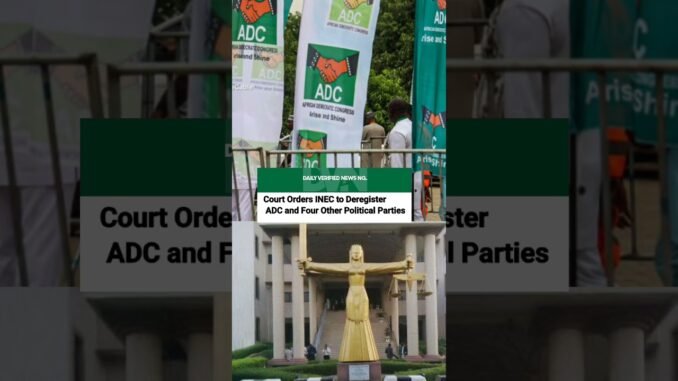

The African Democratic Congress fires back at Federal High Court ruling, describing the judgment as an assault on democracy and opposition politics in Nigeria
—
The African Democratic Congress (ADC) has come out swinging against a recent Federal High Court judgment that ordered the party’s deregistration, labeling the decision as nothing short of “judicial rascality” designed to weaken opposition voices in Nigeria’s political landscape.
The party has announced plans to petition the National Judicial Council (NJC) over what it describes as a brazen attempt to use the judiciary to silence alternative political platforms and stifle democratic competition ahead of future elections.
A Judgment That Raises Questions
According to ADC leadership, the Federal High Court ruling represents a dangerous precedent that threatens the foundation of multi-party democracy in Nigeria. The party argues that the judgment lacks constitutional backing and appears motivated by forces seeking to consolidate political power by eliminating viable opposition parties.
Bolaji Abdul, speaking on behalf of the party, expressed shock and disappointment at the ruling, questioning the legal reasoning behind a decision that could effectively erase a registered political party from Nigeria’s democratic space.
“This is not just an attack on ADC; it is an attack on democracy itself,” the party maintained, signaling its readiness to pursue all legal avenues to overturn what it considers a miscarriage of justice.
Why This Matters to Nigerian Democracy
The ADC’s planned petition to the NJC highlights growing concerns about judicial independence and the role of courts in safeguarding democratic principles. With Nigeria’s 2027 general elections on the horizon, the deregistration of opposition parties sends a chilling message about the state of political competition in the country.
Many political watchers have pointed out that a vibrant democracy requires strong opposition parties to provide checks and balances. Any move perceived as weakening this structure raises legitimate questions about Nigeria’s commitment to democratic ideals.
The ADC has made it clear that it will not go down without a fight, promising to mobilize legal resources and rally support from civil society organizations and concerned Nigerians who believe in the sanctity of multi-party democracy.
What Happens Next?
As the ADC prepares its petition to the National Judicial Council, all eyes will be on how Nigeria’s judicial oversight body responds to allegations of judicial misconduct. The outcome of this confrontation could have far-reaching implications for opposition politics and the independence of Nigeria’s judiciary.
The party has called on all Nigerians who value democracy to stand with them in resisting what they describe as an authoritarian creep into the nation’s judicial system.
—
This developing story reflects ongoing tensions in Nigeria’s political landscape as parties and democratic institutions navigate complex legal and constitutional questions ahead of future elections.
Be the first to comment