
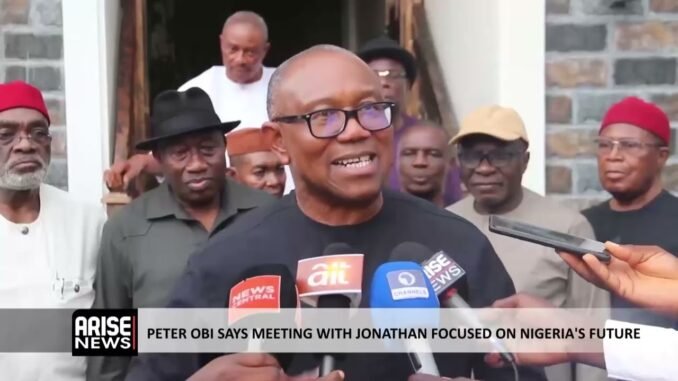

Summary: Labour Party’s Peter Obi reveals what transpired during his private meeting with ex-President Goodluck Jonathan, discussing Nigeria’s future and national development strategies.
Former Labour Party presidential candidate, Peter Obi, has finally broken his silence on the details of his recent closed-door meeting with former President Goodluck Jonathan, describing it as a highly productive discussion centered on charting a better course for Nigeria’s future.
The meeting, which had sparked widespread speculation across Nigerian political circles and social media platforms, brought together two of the country’s most influential political figures for what Obi now characterizes as a forward-looking conversation about the nation’s trajectory.
A Meeting of Minds on Nigeria’s Future
According to Obi, the discussion with the former President was far from mere political positioning or alliance-building. Instead, it represented a sincere exchange of ideas between two leaders who have demonstrated commitment to Nigeria’s progress at different points in the nation’s democratic journey.
“Our conversation was deeply focused on the future of our dear country,” Obi revealed, emphasizing that both men share genuine concerns about the direction Nigeria is heading and the urgent need for visionary leadership to address the mounting challenges facing ordinary Nigerians.
Beyond Party Lines
The meeting is particularly significant given that it transcends party affiliations. Jonathan, who led Nigeria from 2010 to 2015 under the Peoples Democratic Party (PDP), and Obi, who contested the 2023 presidential election on the Labour Party platform, both represent different political traditions but appear united in their desire to see Nigeria fulfill its potential.
For many Nigerians who followed the 2023 elections closely, Obi’s emergence as a formidable political force represented a departure from traditional politics-as-usual. His meeting with Jonathan, a statesman who voluntarily conceded defeat in 2015 to preserve peace, signals a possible new chapter in Nigerian political discourse—one where national interest supersedes partisan considerations.
What This Means for Nigerian Politics
Political analysts have been quick to interpret the significance of this meeting. Some see it as Obi building bridges with established political figures, while others view it as Jonathan’s continued relevance in shaping Nigeria’s political conversation even years after leaving office.
Whatever the interpretation, one thing remains clear: both men understand that Nigeria’s challenges—from insecurity to economic hardship, unemployment to infrastructure deficits—require collaborative thinking and strategic planning that goes beyond individual ambitions or party manifestos.
The Road Ahead
As Nigeria navigates its current economic and security challenges, meetings like this between respected political figures offer a glimmer of hope that the country’s leadership class can rise above differences to forge solutions.
Obi’s willingness to engage with leaders across the political spectrum demonstrates the kind of maturity and statesmanship that many Nigerians have been calling for. Similarly, Jonathan’s continued engagement in national discourse shows that his commitment to Nigeria extends beyond his time in office.
While the full details of their discussion remain private, the fact that both leaders are thinking deeply about Nigeria’s future and engaging in meaningful dialogue is, in itself, a positive development for a nation hungry for visionary leadership and genuine progress.
As the 2027 election cycle gradually comes into view, Nigerians will be watching closely to see how such meetings translate into concrete actions and whether they signal new political alignments or simply represent elder statesmen comparing notes on the state of the nation.
Check buzzUp9ja for more details
Be the first to comment