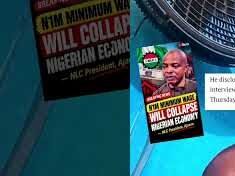

Summary: NLC President Joe Ajaero has broken down exactly why demanding a ₦1 million minimum wage could do more harm than good for Nigeria’s economy. Here’s what you need to know.
—
If you’ve been following the ongoing minimum wage conversation in Nigeria, you’ve probably heard figures flying around like pepper soup ingredients at a bukas — everyone has an opinion. But when the President of the Nigeria Labour Congress (NLC), Joe Ajaero, speaks on the matter, Nigerians sit up and listen.
In a recent interview, Ajaero did something many didn’t expect — he explained why pegging Nigeria’s minimum wage at ₦1,000,000 (one million naira) would actually be bad news for the Nigerian economy, not the blessing workers are hoping for.
—
So, What Did Ajaero Actually Say?
The NLC boss, who has been at the forefront of the fight for better wages for Nigerian workers, made it clear that while every Nigerian worker deserves to earn a living wage, throwing out an unrealistic figure like ₦1 million could trigger a catastrophic economic collapse.
His argument is straightforward: if employers — both private and government — are suddenly forced to multiply their wage bills by massive figures, the consequences would ripple across every sector of the economy faster than a NEPA light outage during a Premier League final.
—
Breaking It Down: The Real Economic Danger
Here’s why a ₦1 million minimum wage could backfire on the very workers it’s meant to help:
1. Mass Job Losses
Many Nigerian businesses, especially Small and Medium Enterprises (SMEs) — the backbone of our economy — are already struggling under the weight of high fuel costs, unstable electricity, and forex wahala. Forcing them to pay ₦1 million per worker monthly would push most of them to either shut down completely or automate jobs, leaving millions of Nigerians worse off than before.
2. Inflation Would Go Through the Roof
Any sharp, unstructured increase in wages without a corresponding boost in productivity typically leads to inflation. Businesses would simply transfer the extra costs to consumers. That means the price of everything — from garri to generator fuel — would skyrocket even further. The purchasing power of that ₦1 million would shrink almost immediately.
3. Government Wage Bill Crisis
Nigeria’s federal and state governments are already groaning under the weight of their current wage bills. Many states can barely pay the existing minimum wage consistently. A jump to ₦1 million would make salary payments nearly impossible for most state governments, leading to more months of unpaid salaries — a problem Nigerians know all too well.
4. Business Flight and Investment Drought
Investors and businesses looking at Nigeria would think twice before setting up operations if the minimum labour cost is that high — especially when neighbouring countries offer cheaper, competitive labour markets. This could mean fewer jobs created in the long run.
—
But Wait — Workers Are Suffering Too
To be fair, nobody is arguing that Nigerian workers don’t deserve better. With the current economic reality — where a bag of rice costs a small fortune and transport fares have tripled — earning anything less than a living wage is genuinely painful.
Ajaero and the NLC have consistently pushed for wages that reflect the cost of living*, not just political optics. The real conversation, therefore, isn’t whether workers deserve more — they absolutely do. It’s about finding a *sustainable, realistic figure that protects jobs, keeps businesses alive, and still puts more money in workers’ pockets.
—
The Bottom Line
The minimum wage debate in Nigeria is far from over, and it sits at the intersection of economic survival and social justice. Joe Ajaero’s position reminds us that labour advocacy isn’t just about demanding the highest number possible — it’s about demanding what the system can actually deliver without breaking it.
As Nigerians, we want a future where every worker can afford three square meals, school fees, and maybe even a little savings. But getting there requires honest, data-driven conversations — not just figures that sound good on a protest banner.
FWhat do you think? What should Nigeria’s minimum wage realistically be? Drop your thoughts in the comments below. 👇
Follow for more news on buzzUp9ja
Be the first to comment