
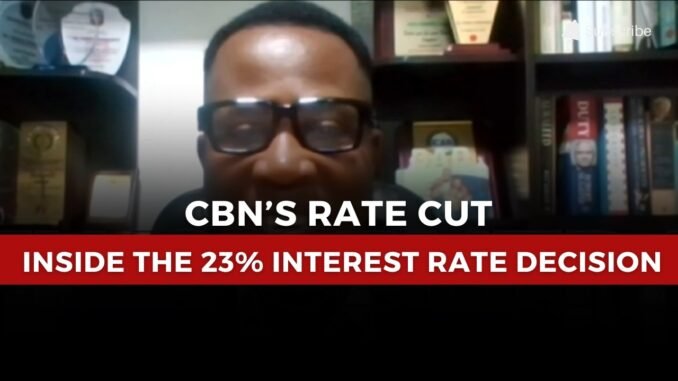

In a move that has set the financial world buzzing, the Central Bank of Nigeria (CBN) has announced a significant reduction in its benchmark interest rate — dropping it from 26.5 per cent to 23 per cent*. This decision came on the heels of the *307th Monetary Policy Committee (MPC) meeting, held in Abuja.
But what does this really mean for the average Nigerian — the trader in Alaba market, the Lagos Island banker, the Abuja civil servant, or the small business owner hustling in Onitsha? Let’s break it down.
What Is the Benchmark Interest Rate and Why Should You Care?
Think of the CBN’s benchmark interest rate — officially called the Monetary Policy Rate (MPR) — as the “master rate” that controls how expensive or cheap money is across Nigeria. When the CBN sets this rate high, borrowing becomes costly for banks, and that cost trickles down to you when you take a loan. When it comes down, borrowing potentially becomes more affordable.
In simple terms: a lower MPR can mean cheaper loans for businesses and individuals.
From 26.5% Down to 23% — A Bold Step
This cut of 3.5 percentage points is no small matter. For context, the CBN had been aggressively hiking rates over the past couple of years in a bid to tame Nigeria’s stubborn inflation — which had been biting hard into the purchasing power of millions of Nigerians.
The fact that the MPC has now decided to pivot and reduce rates suggests that policymakers believe inflation pressures may be easing*, and that it is time to shift focus toward *stimulating economic growth.
What This Could Mean for Nigerians
💰 For Borrowers and Business Owners
If you’ve been holding off on taking a business loan because the interest rates were simply too savage, this cut could be good news. Commercial banks are expected — at least in theory — to gradually reduce their lending rates, making credit more accessible for SMEs, manufacturers, and entrepreneurs looking to expand.
🏠 For Mortgage and Housing
Cheaper borrowing costs could also breathe fresh air into Nigeria’s struggling housing sector. More Nigerians might find it slightly easier to access mortgage financing as rates begin to ease.
📉 For Savers
Here’s the flip side — if you have money sitting in a fixed deposit or savings account, a rate cut typically means lower returns on your savings. Banks may start offering less attractive interest on deposits.
🛒 For Everyday Nigerians Battling Inflation
A rate cut can be a double-edged sword. While it stimulates growth, it also risks putting more money into circulation, which could add pressure to inflation if not carefully managed. Nigerians already know too well the pain of rising food prices and a weakening naira — so all eyes will be on how this plays out.
The CBN’s Balancing Act
The CBN Governor and the MPC members are essentially walking a tightrope. On one side is the need to cool inflation and stabilise the naira*; on the other is the urgent need to *grow the economy and reduce unemployment.
By cutting rates at this point, the CBN appears to be signalling greater confidence that the inflation battle is progressing — and that Nigeria’s economy now needs a shot of energy.
The Bottom Line
The reduction of Nigeria’s interest rate to 23 per cent is a significant policy shift that could have wide-ranging effects — from how much you pay on your next bank loan to how the broader Nigerian economy performs in the months ahead.
As always with economic policy, the proof will be in the pudding. Nigerians will be watching closely to see whether this bold move by the CBN translates into real relief — lower loan rates, business growth, and ultimately, more money in people’s pockets.
Stay with us for more updates as this story develops.
Follow the latest news on buzzUp9ja
Be the first to comment