
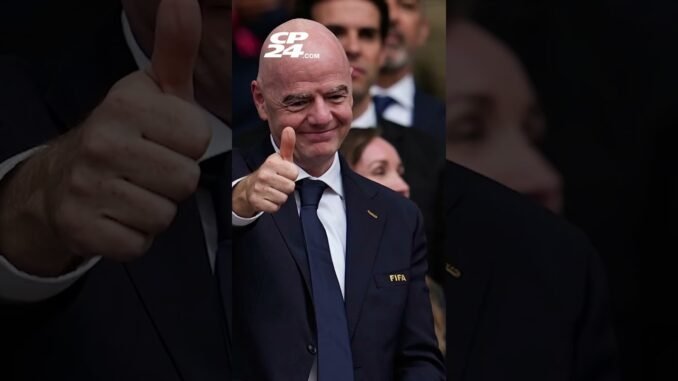

Summary: All 41 CONCACAF member nations have joined European football bodies to firmly reject FIFA’s controversial plan to sell stakes in the FIFA World Cup to private investors — and the football world is watching closely.
—
In a move that has sent shockwaves through the global football community, all 41 member countries of the Confederation of North, Central America and Caribbean Association Football (CONCACAF) have officially rejected FIFA’s controversial proposal to sell ownership stakes in the FIFA World Cup to private investors.
And they didn’t do it alone — Europe’s football powerhouses stood firmly beside them.
What Is FIFA Actually Proposing?
For those who may not have been following the gist closely, FIFA — the global body that governs football worldwide — has been exploring the idea of bringing in private investors to buy stakes in the FIFA World Cup, arguably the biggest sporting event on the planet.
In simple terms? They want to sell a piece of the World Cup — our World Cup — to businesspeople and investment firms who are primarily motivated by profit, not the love of the beautiful game.
As you can imagine, that did not sit well with many.
CONCACAF Leads the Pushback
CONCACAF, which oversees football across 41 nations spanning the Caribbean, North America, and Central America, has now formally added its voice to the growing chorus of opposition. This is not a small group of countries murmuring complaints — this is a unified, continent-wide rejection.
And when you combine that with UEFA (the body governing European football), which represents some of the most powerful football nations in the world, you begin to understand just how much pressure FIFA is now facing.
The message from both confederations is clear: the World Cup is not for sale.
Why Should Nigerians Care About This?
Omo, this matter concerns us directly.
Nigeria is a member of CAF — the Confederation of African Football — and while CAF has not yet made a loudly publicised stance on this issue, what happens to the governance of the World Cup affects every football-loving nation, including the home of the Super Eagles.
Think about it this way: if private investors gain significant stakes in the World Cup, decisions about the tournament — from hosting rights to broadcasting deals to ticket pricing — could increasingly be driven by profit margins rather than the interests of football fans and member nations.
That means the Super Eagles qualifying for the World Cup, or Nigeria ever hosting one, could become even more complicated in a landscape shaped by investor interests.
The Bigger Picture: Football Governance Under Threat?
This debate is part of a much larger conversation about who truly owns football. In recent years, we’ve seen private money flood into the sport — from the controversial Super League proposal that almost tore European football apart, to Saudi-backed takeovers and Gulf-state investments reshaping club football.
Each time, the question remains the same: When money enters football in such massive proportions, who loses out?
The answer, more often than not, is the ordinary fan.
A Victory for Football Democracy — For Now
The unanimous rejection by all 41 CONCACAF nations, standing alongside UEFA, represents a significant moment of solidarity in world football governance. It signals that not every confederation is willing to roll over and allow commercialisation to swallow the soul of the game.
But make no mistake — FIFA does not give up easily. With billions of naira (and dollars) potentially on the table, this conversation is far from over.
Football lovers across Nigeria and Africa would do well to stay informed and vocal. Because when the biggest decisions in football are being made, silence is never in our best interest.
—
Follow buzzUp9ja for more football news, analysis, and gist that matters to Nigerian fans.
Be the first to comment