
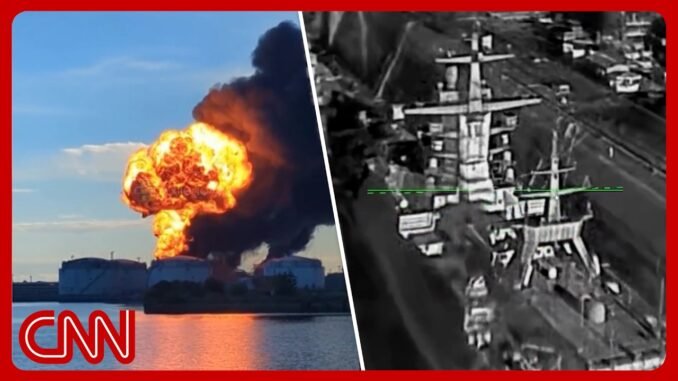

In a dramatic escalation that has sent shockwaves through international circles, Ukrainian drones successfully struck strategic targets in Saint Petersburg—Russia’s second-largest city—early Wednesday morning, June 3. The timing of the attack could not have been more calculated, as it coincided with the opening of a major economic forum often referred to as “Russia’s Davos.”
A Bold Strike at Russia’s Cultural Capital
The drone attack targeted both energy infrastructure and military installations in Saint Petersburg, a city that holds immense historical and cultural significance for Russia. This marks one of the most audacious operations by Ukrainian forces deep inside Russian territory since the conflict began.
For many Nigerians following the war, this development represents a significant shift in Ukraine’s military strategy. Just as we’ve seen in regional conflicts across West Africa, the ability to strike at an adversary’s heartland changes the entire dynamics of warfare.
The “Russian Davos” Under Fire
The timing of the attack was clearly intentional. The Saint Petersburg International Economic Forum, which has earned the nickname “Russian Davos” due to its resemblance to the famous World Economic Forum in Switzerland, brings together Russian officials and international delegates to discuss economic cooperation and investment opportunities.
The forum has traditionally been a showcase event for Russia to project economic strength and attract foreign investment—something Nigeria and other African nations understand well, given our own efforts to attract international partnerships and capital for development.
What This Means for the Global Economy
The attack on Saint Petersburg during such a high-profile gathering sends multiple messages. First, it demonstrates Ukraine’s growing capability to conduct precision strikes far from the front lines. Second, it serves as a stark reminder to international businesses considering Russian partnerships that the conflict remains very real and unpredictable.
For African nations like Nigeria, which have maintained a careful balancing act in their response to the Ukraine-Russia conflict, these developments complicate an already delicate situation. Our country, like many others on the continent, depends on both Russian grain and Ukrainian agricultural products, making neutrality both economically prudent and politically challenging.
The Bigger Picture
As this war continues to evolve, with strikes now reaching major Russian cities, the implications extend far beyond Eastern Europe. Energy markets remain volatile, food security concerns persist, and the geopolitical landscape grows increasingly complex.
Nigerian observers and policymakers will be watching closely to see how Russia responds to this bold attack on its cultural capital, and what it means for the broader trajectory of the conflict.
The message from Kyiv is clear: no Russian city, no matter how important or seemingly distant from the front lines, is beyond reach. Whether this strategy accelerates negotiations or further entrenches both sides remains to be seen.
This is a developing story. Further updates will be provided as more information becomes available.
For more information, check buzzUp9ja
Be the first to comment