
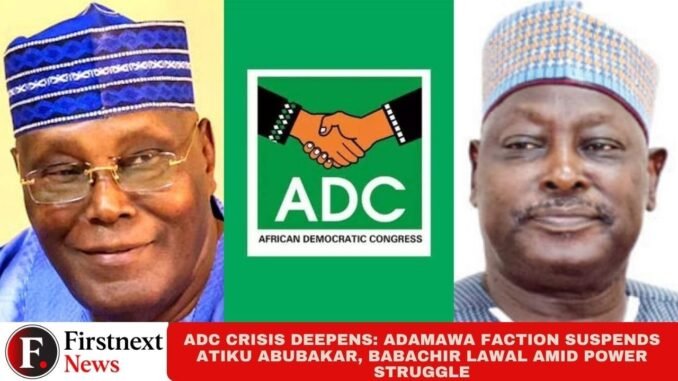

The internal crisis rocking the African Democratic Congress (ADC) has taken a dramatic new twist as a faction of the party in Adamawa State announced the suspension of former Vice President Atiku Abubakar and former Secretary to the Government of the Federation, Babachir Lawal.
The suspension, announced on April 13, marks a significant escalation in the power struggle within the party, raising fresh questions about the ADC’s stability as Nigeria approaches the 2027 general elections.
The Suspension Announcement
According to the Adamawa State faction of the ADC, the decision to suspend both political heavyweights was taken following what they described as anti-party activities. The chairman of the faction made the announcement, signaling deep divisions within the party structure.
This development comes at a critical time when political parties across Nigeria are strategizing and positioning themselves for the 2027 electoral contests. For the ADC, a party that has struggled to make significant national impact despite having notable politicians in its ranks, this internal crisis could prove particularly damaging.
Background to the Crisis
The ADC has been experiencing internal turmoil, with different factions claiming legitimacy and control of party structures. These divisions have become more pronounced as the 2027 elections draw closer, with various interest groups jostling for influence and control.
Atiku Abubakar, a former Vice President and perennial presidential aspirant, has been a prominent figure in Nigerian politics for decades. His involvement with the ADC and subsequent suspension by a faction of the party highlights the complex political calculations at play in Adamawa State and beyond.
Babachir Lawal, who served as SGF during the early years of the Buhari administration before his controversial removal, has also remained active in northern politics and was recently involved in various political alignments.
Implications for 2027
This suspension raises several questions about the ADC’s readiness for the 2027 elections:
– Party Unity: How can a party present a united front to voters when it cannot resolve internal disputes?
– Electoral Viability: Will voters take seriously a party plagued by factional crises?
– Leadership Vacuum: With key figures suspended, who will lead the party’s agenda in Adamawa and nationally?
What Happens Next?
Political observers will be watching closely to see whether the national leadership of the ADC will intervene to resolve this crisis or if the divisions will deepen further. The response from Atiku and Babachir to their suspension will also be crucial in determining the next phase of this political drama.
For Nigerian voters, particularly in Adamawa State, this development serves as another reminder of the volatility of the nation’s political landscape as the country prepares for another electoral cycle.
As this story continues to unfold, one thing remains certain: the road to 2027 will be filled with political surprises, realignments, and power plays that will shape Nigeria’s democratic journey.
Stay tuned for updates on this developing story.
Visit buzzUp9ja for more details
Be the first to comment