
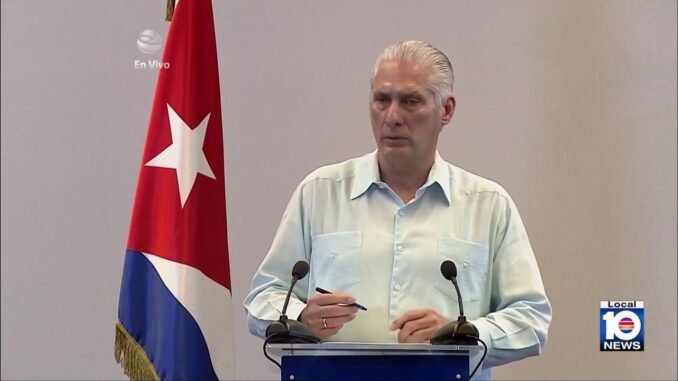

As tensions rise between Washington and Havana, America’s top diplomat rejects claims of regime change agenda
The United States Secretary of State, Marco Rubio, has strongly dismissed reports suggesting that his country is actively working to remove Cuba’s President Miguel Díaz-Canel from power.
In a fiery late-night post on social media platform X (formerly Twitter), Rubio labelled a story by The New York Times as “fake news,” accusing the prestigious newspaper of depending on “charlatans and liars claiming to be in the know” for their information.
What The Report Claimed
The New York Times had reported that officials in the Donald Trump administration have been urging Cuba to remove Díaz-Canel from office. However, according to the newspaper, Washington stopped short of calling for the complete overthrow of Cuba’s communist government.
Rubio’s response did not make it clear whether he was rejecting the entire story or just certain aspects of it. “The reason so many in US media keep putting out fake stories like this one is because they continue to rely on charlatans & liars claiming to be in the know as their sources,” he wrote.
The Background
According to the original report, American officials view President Díaz-Canel as a hardliner who is unlikely to implement the kind of meaningful reforms Washington desires. Still, the US had not issued any direct ultimatum demanding his removal.
Marco Rubio, who is Cuban-American and formerly represented Miami as a senator, has long been one of the most vocal critics of Cuba’s communist system—the government structure established after Fidel Castro’s revolution decades ago.
Rubio has previously stated that Cuba must take more “dramatic” steps beyond its recent measures that allow Cubans living abroad to invest and own businesses on the island. This comes as Cuba faces a severe economic crisis and widespread power outages that have left many citizens frustrated.
Increasing Pressure from Washington
The Trump administration has significantly increased pressure on Cuba through various means, including restricting oil supplies to the island nation. These restrictions have worsened Cuba’s energy shortages and deepened its economic hardship.
President Trump himself has hinted at the possibility of striking a “deal” with Cuba, while at other times boasting about America’s ability to take control of the island, describing it as weak.
What Analysts Are Saying
Despite the heightened rhetoric and economic pressure, political analysts suggest that Washington’s approach toward Cuba—similar to its strategies in Venezuela and Iran—appears focused more on forcing compliance with American demands rather than pursuing outright regime change.
This development adds another layer to the complex relationship between the United States and Cuba, two nations separated by just 90 miles of water but worlds apart in ideology and governance.
As Nigeria continues to navigate its own relationships with global powers, the Cuba-US situation serves as a reminder of how smaller nations can find themselves caught in geopolitical crosshairs, facing external pressure that affects their internal affairs and economic stability.
For more information, check buzzUp9ja
Be the first to comment