
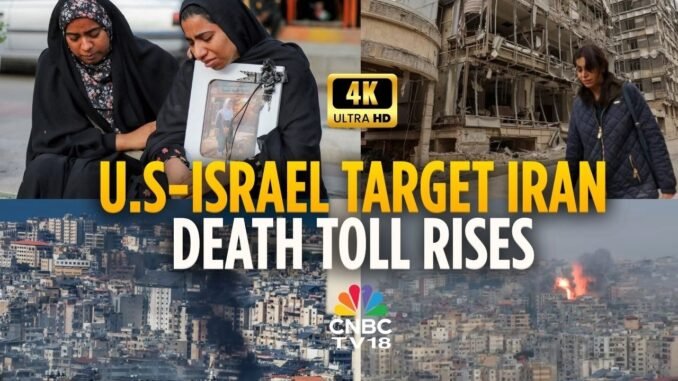

Summary: Breaking developments as US-Israeli military operations target Iranian leadership meeting in Tehran. President Trump declares negotiations “too late” as conflict intensifies across the Middle East.
The ongoing military confrontation between the United States-Israel coalition and Iran has reached a critical new phase, with airstrikes destroying a building in Tehran where senior Iranian officials were gathered to select the country’s next leader.
Trump Declares “Too Late” for Peace Talks
President Donald Trump has firmly rejected Iranian overtures for negotiations following the devastating strikes. Taking to his Truth Social platform, the American leader made his position clear with a blunt message that has sent shockwaves across diplomatic circles.
“Their air defense, Air Force, Navy, and Leadership is gone. They want to talk. I said ‘Too Late!'” Trump wrote, painting a picture of comprehensive military degradation of Iranian capabilities.
This hardline stance marks a significant escalation in rhetoric as the conflict enters what observers are calling a dangerous new territory.
Leadership Transition Interrupted
The airstrikes specifically targeted a crucial gathering of Iran’s Assembly of Experts in Qom, located south of Tehran. These senior clerics had convened with the solemn task of selecting a successor to Ayatollah Khamenei, who reportedly died on Saturday.
According to Iran’s Tasnim news agency, the attack was characterized as the work of “American-Zionist criminals” targeting the Assembly of Experts building. The meeting represented a pivotal moment in Iranian governance, as the Assembly holds constitutional responsibility for choosing the nation’s supreme leader.
Regional Conflict Widens
As the confrontation enters its fourth day, the battlefield has expanded well beyond Iranian borders:
Gulf States Under Fire
Iranian forces have launched retaliatory strikes across the Gulf region:
– United Arab Emirates: Iranian drones successfully attacked another major oil refinery, raising concerns about global energy security and the vulnerability of critical Gulf infrastructure.
– Qatar: The site hosting the largest American military base in the country came under drone attack, demonstrating Iran’s willingness to directly target US military installations.
– Saudi Arabia: The US embassy in Riyadh issued urgent warnings about “imminent” missile and drone attacks following two Iranian drone strikes on the building overnight.
What This Means for Nigeria and Global Markets
For Nigerians closely watching these developments, the implications extend beyond distant headlines:
Oil Market Implications
As a major oil-producing nation, Nigeria’s economy remains sensitive to Middle Eastern instability. Attacks on Gulf refineries typically trigger:
– Potential increases in global oil prices
– Shifts in international energy supply chains
– Possible opportunities or challenges for African oil exporters
Diaspora Concerns
With thousands of Nigerians working across the Gulf region—particularly in the UAE, Qatar, and Saudi Arabia—the expanding conflict zone raises legitimate safety concerns for our citizens abroad.
The Nigerian government and relevant authorities will need to monitor evacuation protocols and provide guidance to nationals in affected areas.
International Response and What Comes Next
The international community now faces critical questions about de-escalation pathways. With Trump’s declaration that it’s “too late” for negotiations, diplomatic channels appear severely constrained.
Regional allies and international organizations will likely intensify efforts to prevent further escalation, though the targeting of leadership succession processes represents an unprecedented development in modern Middle Eastern conflicts.
The Bigger Picture
This conflict transcends typical military confrontations. By targeting Iran’s leadership transition process, the US-Israeli coalition has struck at the heart of Iranian governance structures. The ramifications will likely reshape Middle Eastern geopolitics for years to come.
As events continue to unfold rapidly, Nigerians—whether concerned about economic impacts, diaspora safety, or global stability—should remain informed about these developments that increasingly demonstrate how interconnected our world has become.
This is a developing story. Updates will be provided as more information becomes available.
—
For more breaking international news and analysis, check buzzUp9ja
Be the first to comment