
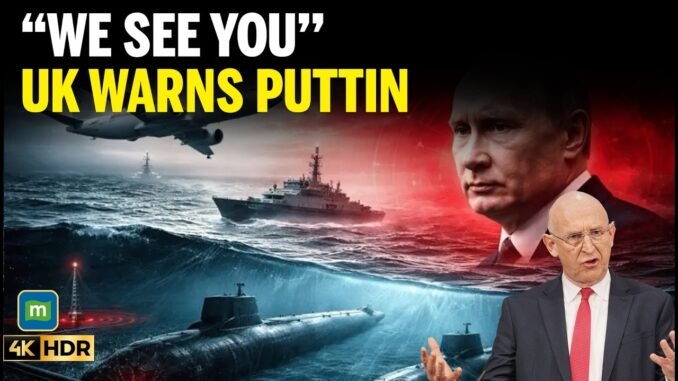

Summary: UK Defence Secretary reveals month-long military operation tracking Russian submarines near British waters. Nigeria takes note as global powers flex military muscle.
The United Kingdom has sent a clear warning to Russian President Vladimir Putin following a massive month-long military operation that involved tracking three Russian spy submarines operating dangerously close to British territorial waters.
UK Defence Secretary John Healey disclosed details of the sophisticated surveillance operation that mobilized over 500 military personnel across multiple branches of the British armed forces. The operation, which many security analysts are calling one of the most significant naval tracking missions in recent years, demonstrates the heightened tensions between NATO powers and Russia.
A Month of Cat-and-Mouse in the Atlantic
The large-scale operation brought together the Royal Navy’s surface vessels, RAF P-8 Poseidon maritime patrol aircraft, and advanced underwater detection systems. For an entire month, British forces maintained round-the-clock surveillance of the three Russian submarines as they prowled through international waters near the UK.
“We see you,” Healey’s message to the Kremlin was unmistakable. “We are watching, and we are ready.”
This bold statement reflects growing concerns among Western powers about Russian military activities, particularly submarine movements that experts believe are aimed at mapping undersea infrastructure, including critical internet cables that carry billions of dollars worth of data daily.
Why Nigerians Should Pay Attention
While this drama plays out in the cold waters of the North Atlantic, the implications stretch far beyond Europe. Nigeria, as Africa’s largest economy and a key player in global energy markets, has strategic interests in maintaining stable international relations and secure maritime routes.
Russian submarine activity near critical infrastructure raises questions about the security of undersea cables that connect Nigeria to the global internet and financial systems. Any disruption to these cables could have serious economic consequences for businesses, banks, and millions of Nigerians who depend on reliable international connectivity.
Additionally, as Nigeria continues to strengthen its own naval capabilities in the Gulf of Guinea—combating piracy and protecting offshore oil installations—there are valuable lessons to learn from how major powers conduct maritime surveillance operations.
The Technology Behind the Operation
The UK deployed some of its most advanced military assets for this operation:
– P-8 Poseidon Aircraft: These sophisticated spy planes are equipped with sensors that can detect submarines even when they’re underwater
– Royal Navy Frigates and Destroyers: Surface vessels that coordinate the tracking effort
– Sonar Networks: Underwater listening stations that can detect submarine movements across vast distances
The coordination required to maintain continuous surveillance for a month demonstrates the UK’s serious investment in defending its waters and critical infrastructure.
Growing Tensions with Moscow
This operation comes amid already strained relations between Russia and Western nations. Since the invasion of Ukraine, NATO countries have significantly increased their military readiness and surveillance of Russian activities.
Russian submarines have been spotted with increasing frequency near critical undersea cables and energy infrastructure. Western intelligence agencies believe Moscow may be mapping these systems for potential sabotage in case of wider conflict.
Nigeria’s Own Maritime Security Challenges
While the UK faces Russian submarines, Nigeria continues its own battle to secure the Gulf of Guinea—one of the world’s most dangerous maritime zones. The Nigerian Navy has made significant strides in recent years, working with international partners to combat piracy, crude oil theft, and illegal fishing.
The UK operation serves as a reminder that maritime security requires constant vigilance, advanced technology, and well-trained personnel—investments that Nigeria has been making to protect its vast coastline and offshore resources.
What Happens Next?
Defence experts believe this public disclosure of the tracking operation is intentional—a psychological operation designed to deter future Russian activities and reassure British allies that the UK remains vigilant.
For Putin, the message is clear: British forces have the capability and determination to monitor Russian military movements, and they’re not afraid to let the world know about it.
As global tensions remain high and military posturing continues, Nigeria and other nations must remain aware of how great power competition affects international stability, maritime security, and the global economic systems we all depend on.
The waters may be cold in the North Atlantic, but the message from London burns hot: “We see you, and we’re watching.”
For more details, check buzzUp9ja
Be the first to comment