
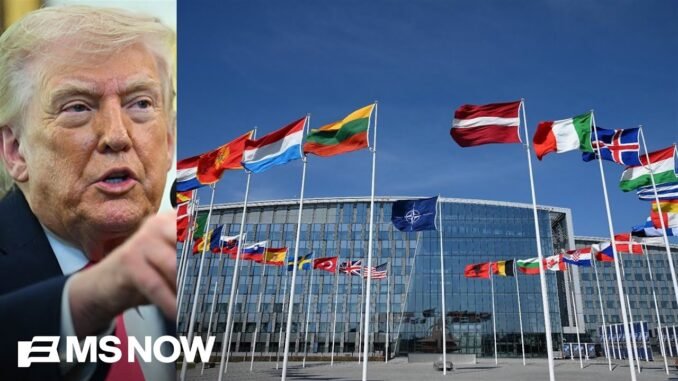

Summary: US President Donald Trump is “strongly considering” withdrawing from NATO, calling the military alliance a “paper tiger.” Here’s what Nigerians need to know about this global power shift.
—
The North Atlantic Treaty Organization (NATO) is facing its most serious existential threat yet, and this time it’s coming from within. US President Donald Trump has once again trained his guns on the 75-year-old military alliance, describing it as a “paper tiger” and openly hinting that America might pull out completely.
For those of us watching from Nigeria and across Africa, this development carries significant implications for global security, international relations, and the balance of power that has shaped our world since the end of World War II.
What Did Trump Actually Say?
In a recent interview that has sent shockwaves through diplomatic circles, President Trump didn’t mince words about his feelings toward NATO. He dismissed the alliance—which brings together 32 countries including the United States, United Kingdom, Canada, Germany, and France—as ineffective and outdated.
The term “paper tiger” is particularly telling. It’s an expression that means something or someone that appears threatening or powerful but is actually weak and ineffective. Trump is essentially saying that NATO looks strong on paper but cannot deliver when it matters.
This isn’t the first time Trump has criticized NATO. During his previous presidency (2017-2021), he repeatedly complained that other member countries weren’t paying their fair share, leaving America to foot most of the bill for Europe’s defense.
Why Should Nigerians Care About NATO?
You might be thinking: “NATO is a European and American matter. Why should we in Nigeria be concerned?” Fair question, but here’s why this matters to us:
1. Global Security Architecture: NATO has been a cornerstone of international security for decades. Any major shift in how the world’s most powerful nations organize their defense affects everyone, including Nigeria’s own security partnerships.
2. Economic Implications: Uncertainty in global security typically shakes financial markets. Nigeria’s economy, already navigating currency challenges and oil price fluctuations, could feel ripple effects from increased global instability.
3. Precedent for Regional Alliances: If NATO—the world’s most successful military alliance—can fall apart, what does that mean for regional organizations like ECOWAS (Economic Community of West African States) that Nigeria belongs to?
4. China and Russia’s Influence: A weakened NATO could embolden countries like China and Russia to expand their influence, including in Africa where they’re already competing heavily for resources and political partnerships.
The Money Problem
At the heart of Trump’s complaints is money. NATO members agreed years ago that each country should spend at least 2% of their GDP (Gross Domestic Product) on defense. However, many European countries have consistently failed to meet this target, while the United States spends far more.
To put this in perspective Nigeria can understand: imagine if in ECOWAS, Nigeria was constantly paying for regional peacekeeping operations while wealthier member states contributed little. That’s essentially how Trump sees America’s position in NATO.
The American president believes his country is being taken advantage of—providing military protection to wealthy European nations that can afford to defend themselves but choose not to.
What Happens If America Leaves NATO?
If Trump follows through on his threat, the consequences would be enormous:
For Europe: Without American military might, European countries would suddenly find themselves vulnerable, especially with an aggressive Russia on their doorstep. The ongoing war in Ukraine would likely take a different turn.
For Global Power Balance: China would likely become even more assertive in Asia and beyond. Russia might feel emboldened to push further into former Soviet territories.
For International Cooperation: It would signal that even the strongest alliances can crumble, potentially weakening other international organizations including the United Nations, World Trade Organization, and regional bodies.
The African Angle
While Nigeria isn’t directly involved in NATO, the alliance’s stability affects our continent in several ways:
– Counterterrorism Support: NATO countries provide intelligence and training support to African nations fighting terrorism, including Nigeria’s battle against Boko Haram and ISWAP.
– Trade and Investment: European NATO members are major trading partners and investors in Nigeria. Security uncertainty in Europe could affect their economic engagement with Africa.
– Mediterranean Security: NATO helps patrol the Mediterranean Sea, affecting migration routes and security issues that impact North African countries and, by extension, the entire continent.
Is This Just Talk or Real Threat?
Trump is known for his unpredictable negotiating style. Some analysts believe his threats are tactical—designed to pressure European countries into increasing their defense spending rather than an actual plan to withdraw.
However, others warn against dismissing his words. Trump pulled the United States out of several international agreements during his first term, including the Paris Climate Accord and the Iran Nuclear Deal, showing he’s willing to follow through on such threats.
What Comes Next?
NATO leaders are likely scrambling behind the scenes to address Trump’s concerns and prevent an American withdrawal. European countries may accelerate their defense spending to meet the 2% target and prove the alliance’s worth.
For Nigeria and other global observers, this situation is a reminder that the international order we’ve known for decades isn’t guaranteed. Alliances shift, powers rise and fall, and countries must always be prepared to adapt.
The Bottom Line
Trump’s latest attack on NATO represents more than just another controversial statement from an unpredictable leader. It signals a potential fundamental shift in how the world’s most powerful nation views its international commitments and alliances.
Whether Trump is serious about withdrawing or simply using tough talk to extract concessions, the uncertainty itself is damaging. In international relations, as in life, trust and predictability matter.
For Nigeria, this is a moment to watch carefully and draw lessons for our own regional partnerships. It’s also a reminder that in today’s interconnected world, what happens in Washington or Brussels doesn’t stay there—it echoes all the way to Lagos, Abuja, and beyond.
As we navigate our own security challenges in the Sahel, the Lake Chad region, and beyond, the stability of global institutions and alliances matters more than we might think.
The world is watching to see if Trump’s words turn into action—and if they do, we’ll all feel the consequences.
Follow for more on buzzUp9ja
Be the first to comment