

As tensions escalate in the Middle East, the traditionally strong alliance between America and Britain faces new diplomatic strain
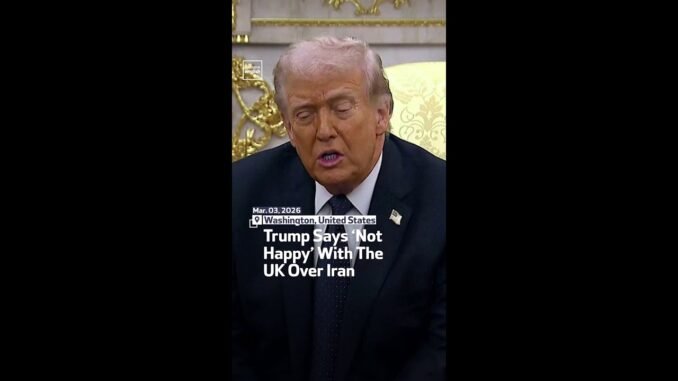
The famous “special relationship” between the United States and the United Kingdom appears to be experiencing turbulence, following sharp criticism from US President Donald Trump directed at British Prime Minister Keir Starmer.
In a strongly-worded interview with British newspaper The Sun, Trump expressed disappointment with how Starmer handled recent US-Israeli military strikes against Iran, describing the UK leader as “not helpful” during what he called a critical moment for Western allies.
“I never thought I’d see that. I never thought I’d see that from the UK. We love the UK,” Trump said, adding that the relationship between the two nations is “not like it used to be.”
The Source of the Disagreement
The diplomatic friction stems from recent US-Israeli military operations targeting Iranian missile launch sites and storage facilities. While Prime Minister Starmer eventually granted the United States permission to use British military bases for what he termed a “specific and limited defensive purpose,” he made clear that the UK would not participate in direct offensive operations against the Iranian government.
This measured approach did not sit well with President Trump, who, in a separate interview with The Telegraph, complained that Starmer “took far too long” to approve the use of British bases. Trump suggested the delay was due to concerns about the legality of the military action—a hesitation he viewed as unhelpful during a time requiring swift allied coordination.
Starmer Defends His Position
Responding to Trump’s criticism before the UK Parliament, Prime Minister Starmer stood firm on his decision, insisting he acted in Britain’s national interest. He emphasized that the UK’s choice not to participate in the “initial” strikes was both deliberate and carefully considered.
“We all remember the mistakes of Iraq, and we have learnt those lessons,” Starmer told parliament, referencing the controversial 2003 invasion that remains a painful memory for many Britons and a cautionary tale about rushing into Middle Eastern conflicts without proper legal justification.
Government minister Darren Jones backed Starmer’s approach, explaining that the UK would only engage in military action where there was a “legal basis” and a “clear plan” aligned with British national interests.
“That’s why we were not involved in the initial strikes in Iran,” Jones said. “But it is also why we’ve consented to American air forces using our air bases and for British jets to be in the sky in order to defend British citizens who are currently in the region.”
The Bases Involved
Two UK military facilities have now been cleared for American use: one located in Gloucestershire in western England, and the joint UK-US base on Diego Garcia island in the Indian Ocean. According to Downing Street, Starmer approved this access after Iran fired missiles over the weekend that put British interests and citizens “at risk.”
What This Means for the Special Relationship
For decades, the US-UK alliance has been described as the “special relationship”—a partnership built on shared language, history, democratic values, and military cooperation. From World War II to the war on terror, the two nations have stood shoulder-to-shoulder through numerous global crises.
However, Trump’s public rebuke of Starmer suggests this bond may be experiencing one of its most challenging periods in recent memory. The American president’s assertion that the US remains a “very dominant power” while lamenting Britain’s lukewarm support signals a shift in how Washington views its transatlantic ally.
“It’s just a much different kind of relationship… It’s very sad to see that the relationship is obviously not what it was,” Trump said during the telephone interview.
A Nigerian Perspective
For Nigerians watching these developments, the situation offers important lessons about sovereignty, international alliances, and the difficult balancing act small and medium powers must perform when caught between competing global interests.
Just as Nigeria navigates complex relationships with Western powers, China, and regional African partners, the UK’s measured response to American pressure demonstrates that even traditional allies must carefully weigh their national interests before committing to military action.
The shadow of Iraq—where unfounded claims about weapons of mass destruction led to a catastrophic war—looms large over British decision-making, much as Nigeria’s own experiences with colonial interference inform our foreign policy choices.
Looking Ahead
As the situation in the Middle East continues to evolve, the diplomatic tension between Washington and London raises important questions: Can the special relationship survive this moment of disagreement? Will other traditional American allies follow Britain’s example of cautious engagement? And what does this rift mean for global stability as Iran crisis deepens?
For now, Prime Minister Starmer appears willing to weather Trump’s criticism, betting that protecting British sovereignty and learning from past mistakes is worth temporary diplomatic discomfort with America’s unpredictable president.
—
What do you think about the UK’s cautious approach to the Iran situation? Should allies always support each other’s military actions, or is it reasonable for each nation to make independent decisions based on their own interests? Share your thoughts in the comments below.
buzzUp9ja has more details for you.
Be the first to comment