
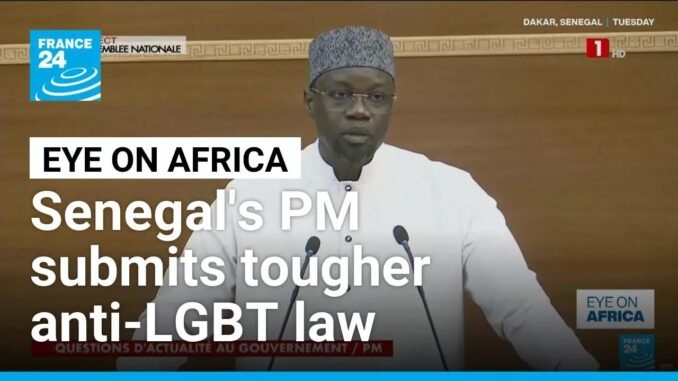

Senegal’s National Assembly has passed a controversial bill that doubles the maximum prison sentence for same-sex relations from five to ten years. The legislation, which sailed through parliament with 135 votes in favour, zero against, and only three abstentions, now awaits the signature of President Bassirou Diomaye Faye.
The new law represents a significant escalation of existing legislation and fulfils a campaign promise made by the government that came to power in 2024, led by President Faye and Prime Minister Ousmane Sonko.
What the New Law Contains
Under Senegal’s previous penal code, last amended in 1966, “acts against nature” carried a maximum sentence of five years imprisonment and fines up to 1.5 million CFA francs (approximately ₦1.5 million or $2,700).
The newly passed legislation not only doubles the maximum prison term but also significantly increases financial penalties to 10 million CFA francs (roughly ₦10 million). Additionally, the law removes judicial discretion that previously allowed judges to grant suspended sentences or reduce prison terms below the minimum threshold.
The bill specifically defines “acts against nature” to include homosexuality, bisexuality, “transsexuality,” zoophilia, and necrophilia. Furthermore, it criminalises any efforts to promote or finance such activities, with offenders facing substantial prison time.
Religious and Civil Society Pressure
Imam Babacar Sylla, leader of And Samm Jikko Yi—a network comprising Islamic and civil society organizations—has publicly urged President Faye to sign the bill into law immediately.
“The longer it takes, the more complicated it will be. And these people, whom I consider a public danger, will continue to escape,” Sylla stated, reflecting the sentiment of many supporters of the legislation.
In the weeks leading up to Wednesday’s parliamentary vote, supporters of the bill, including lawmakers from the ruling Pastef party, organised demonstrations in Dakar. Protesters chanted “No to homosexuality!” and carried placards featuring crossed-out rainbow symbols.
Wave of Arrests Precedes Legislative Action
The period surrounding the bill’s passage has witnessed a dramatic surge in arrests of men suspected of “acts against nature.” In some cases, individuals have also been charged with the “voluntary transmission” of HIV—a separate offence that carries up to 10 years in prison under Senegalese law.
According to the International Federation for Human Rights, approximately 27 men were arrested between February 9 and 24 alone, highlighting the intensified enforcement climate surrounding the issue.
Regional Trend Across West Africa
Senegal’s legislative action mirrors similar developments across West Africa. Last year, Burkina Faso passed legislation criminalising same-sex relations for the first time, imposing prison sentences of up to five years.
Meanwhile, lawmakers in Ghana are currently considering proposals to increase the maximum penalty for same-sex acts from three to five years. The Ghanaian bill would also impose jail time for the “wilful promotion, sponsorship or support of LGBTQ+ activities.”
These legislative moves reflect broader cultural and religious attitudes prevalent across much of West Africa, where traditional values and religious teachings remain deeply influential in shaping public policy and social norms.
What Happens Next?
The bill now sits on President Bassirou Diomaye Faye’s desk, awaiting his signature to become law. Given that the legislation fulfils a key campaign promise and passed with overwhelming parliamentary support, observers expect the president to sign it into law shortly.
Once enacted, Senegal will join a growing list of African nations with stringent laws against same-sex relations, marking a significant moment in the country’s legal and social landscape.
For more information, check buzzUp9ja
Be the first to comment