
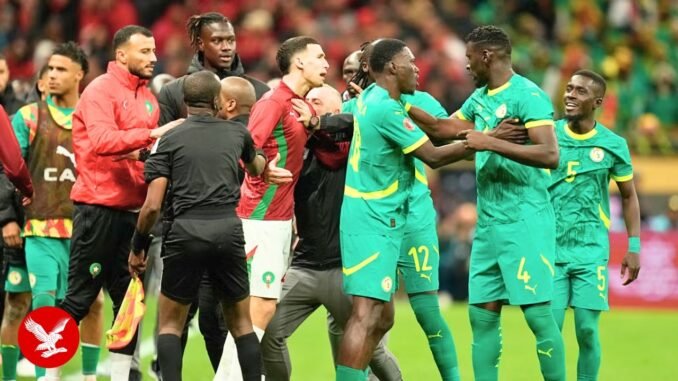

Summary: Senegal government calls for international investigation after CAF reversed AFCON final result, awarding title to Morocco despite Senegal’s 1-0 victory on the pitch.
The Confederation of African Football (CAF) has found itself at the centre of a major controversy after stripping Senegal of its Africa Cup of Nations title and handing the trophy to Morocco in a shocking reversal that has left the football world stunned.
The drama unfolded weeks after the tournament final held in Rabat on January 18, where Senegal defeated Morocco 1-0 in extra time. Now, nearly two months later, CAF has overturned that result, sparking outrage from the Senegalese government and football community.
What Happened During the Final?
The controversy began during the dying moments of the AFCON final when Morocco was awarded a contentious penalty in stoppage time. Senegalese players, feeling hard done by the decision, briefly walked off the pitch in protest—a moment that would later come back to haunt them.
Captain Sadio Mané, the former Liverpool and Bayern Munich star, intervened to convince his teammates to return to the field. Morocco subsequently missed the penalty, and the match went into extra time where Pape Gueye scored the winning goal, giving Senegal a 1-0 victory and what they believed was their second AFCON title.
CAF’s Controversial Decision
On Tuesday, March 17, CAF dropped a bombshell announcement: they had upheld Morocco’s appeal and ruled that Senegal forfeited the match due to the walk-off protest. The official result was recorded as 3-0 in favour of Morocco, and the title was reassigned to the host nation.
This decision has been described by many observers as unprecedented in modern African football, with questions raised about the timing and rationale behind overturning a match result that had been settled on the pitch weeks earlier.
Senegal Government Fires Back
The Senegalese government wasted no time in condemning the ruling. Government spokeswoman Marie Rose Khady Fatou Faye issued a strongly worded statement that pulled no punches.
“By calling into question a result achieved at the end of a match that was properly played and won in accordance with the rules of the game, CAF seriously undermines its own credibility,” she declared.
Faye described the decision as “grossly illegal and profoundly unjust” and announced that Senegal would be pursuing all available legal remedies, including filing an appeal with the Court of Arbitration for Sport (CAS) within 48 hours.
“Senegal unequivocally rejects this unjustified attempt at dispossession,” she added, calling for an independent international investigation into alleged corruption surrounding the decision.
Legal Battle Ahead
The secretary-general of the Senegalese Football Federation has formally requested that CAF suspend enforcement of its decision and halt any process to physically return the trophy to Morocco while arbitration proceedings are ongoing.
This case is expected to test the limits of CAF’s authority and could set important precedents for how match protests are handled in African football going forward.
The Human Cost
Beyond the sporting and political controversy, there’s a human dimension to this crisis. Eighteen Senegalese fans remain detained in Morocco following unrest that erupted during the match.
These supporters were convicted in February on charges including violence against security personnel and property damage. They received prison sentences ranging from three months to one year, alongside financial penalties.
The Senegalese government has expressed solidarity with these detained citizens and says it’s working to secure their release as part of broader efforts to resolve the diplomatic fallout from the tournament.
What This Means for African Football
This controversy raises serious questions about governance in African football. Many fans across the continent are asking: Can match results be overturned weeks after the fact? What message does this send about the finality of on-field decisions?
For Nigeria and other African football nations, the case sets a worrying precedent. If results can be reversed through administrative appeals long after matches conclude, it undermines the integrity of competitions and could open the door to endless disputes.
The Road Ahead
As Senegal prepares its case for the Court of Arbitration for Sport, football fans across Africa and beyond will be watching closely. The outcome could reshape how continental football is governed and what remedies are available when teams feel aggrieved by officiating decisions.
For now, the trophy’s rightful home remains in dispute, Senegalese fans remain in Moroccan custody, and CAF faces perhaps its biggest credibility crisis in recent memory.
One thing is certain: this AFCON final controversy is far from over, and its resolution will have implications that extend well beyond the borders of Senegal and Morocco.
What do you think about CAF’s decision? Should match results be overturned through appeals after they’ve been settled on the pitch? Share your thoughts in the comments below.
Check buzzUp9ja for more details
Be the first to comment