
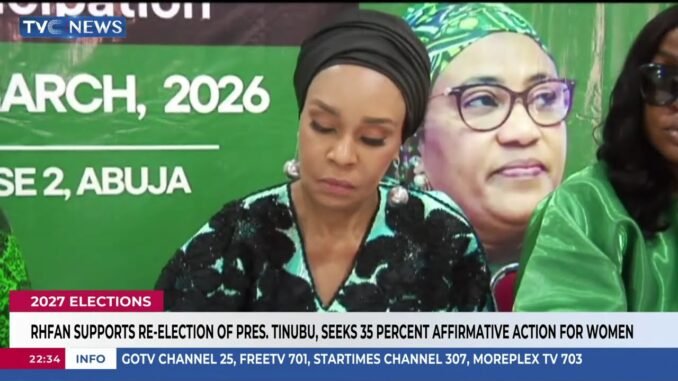

Summary: Renewed Hope Female Aspirants Network demands 35% affirmative action for women in Nigerian politics while pledging support for President Tinubu’s reform agenda.
The conversation around women’s participation in Nigerian politics has taken a decisive turn as the Renewed Hope Female Aspirants Network (RHFAN) intensifies its advocacy for gender inclusion in the country’s political landscape.
The women’s political group has thrown its weight behind President Bola Ahmed Tinubu’s Renewed Hope Agenda while simultaneously calling for concrete action to address the glaring gender imbalance that continues to plague Nigeria’s political system.
The 35% Demand: A Game-Changer for Nigerian Women
At the heart of RHFAN’s advocacy is a bold demand: the implementation of a 35% affirmative action policy for women across all political positions in Nigeria. This isn’t just about numbers—it’s about fundamentally reshaping who gets a seat at the table where crucial decisions affecting over 100 million Nigerian women are made.
The call for 35% representation aligns with international best practices and recommendations from bodies like the United Nations and the African Union, which recognize that sustainable development cannot be achieved without the full participation of women in governance.
Why This Matters Now
Nigeria’s political space remains overwhelmingly male-dominated. Despite women constituting nearly half of the country’s population and playing pivotal roles in electoral victories, their representation in elected positions tells a different story entirely.
Current statistics paint a sobering picture: women occupy less than 6% of seats in the National Assembly, and female representation in state houses of assembly and local government councils remains abysmally low. For a nation that prides itself as the “Giant of Africa,” these numbers are far from giant-like.
RHFAN’s intervention comes at a critical moment when President Tinubu’s administration is implementing various reforms aimed at repositioning Nigeria for sustainable growth. The group argues that true national renewal cannot happen without deliberate policies that bring women from the margins to the centre of political decision-making.
Supporting Tinubu While Demanding More
What makes RHFAN’s approach particularly strategic is its dual focus: supporting the current administration’s reform agenda while pushing for specific gender-focused interventions.
The group has expressed commitment to mobilizing women across Nigeria’s six geopolitical zones to support policies under the Renewed Hope Agenda that promote economic growth, security, and social development. However, they’re making it clear that their support comes with expectations.
RHFAN is calling on the Tinubu administration to establish robust mechanisms that will:
– Promote genuine gender equality in political appointments and nominations
– Expand electoral opportunities for female aspirants through party reforms
– Create enabling environments for women to contest and win elections
– Enforce existing gender policies and introduce new legislative frameworks
The Economic and Social Case for Women’s Political Inclusion
Beyond the moral argument for fairness, there’s compelling evidence that women’s political participation drives better outcomes for entire communities.
Research across Africa and globally shows that when women are involved in political decision-making, there’s increased focus on education, healthcare, social welfare, and anti-corruption measures. Nigerian women have consistently demonstrated their capacity for effective leadership in various sectors—from finance and education to civil society and business.
The question RHFAN is essentially asking is: Why should politics be any different?
Challenges Ahead
The road to 35% affirmative action won’t be smooth. Nigeria’s political establishment has historically resisted quotas and affirmative action policies, often citing “merit” and “competence” as reasons—arguments that conveniently ignore the structural barriers that prevent qualified women from accessing political opportunities in the first place.
Cultural attitudes, financial constraints, violence against women in politics, and entrenched patronage networks all work against female political aspirants. RHFAN’s advocacy recognizes these realities, which is why they’re calling for systemic interventions rather than mere rhetoric.
What Needs to Happen Next
For RHFAN’s demands to translate into reality, several actions are necessary:
Legislative action: The National Assembly must revisit and pass gender equality bills that provide legal backing for affirmative action in politics.
Party reforms: Political parties must amend their constitutions to guarantee minimum percentages for women in party leadership and electoral tickets.
Financial support: Special funds and reduced nomination fees for female aspirants would level the playing field.
Security measures: Protection mechanisms for women in politics must be established to address the intimidation and violence many female politicians face.
Cultural shift: A nationwide reorientation campaign is needed to challenge patriarchal attitudes that view politics as a “man’s game.”
The Bigger Picture
RHFAN’s advocacy is part of a broader movement of Nigerian women who are refusing to accept political marginalization as normal or inevitable. From the #NotTooYoungToRun movement to various women’s rights organizations, there’s growing momentum for transforming Nigeria’s political landscape.
President Tinubu’s administration has an opportunity to be on the right side of history by taking concrete steps toward gender inclusion. The “Renewed Hope” agenda will ring hollow if it doesn’t include deliberate hope for Nigeria’s women who have long been sidelined despite their contributions to nation-building.
As Nigeria faces complex challenges—from insecurity and economic instability to unemployment and infrastructure deficits—the country cannot afford to sideline half its population. The talents, perspectives, and leadership of Nigerian women are not optional luxuries; they’re essential ingredients for national progress.
Conclusion
The call for 35% affirmative action for women in Nigerian politics is neither radical nor unreasonable. It’s a practical step toward correcting historical imbalances and building a more inclusive democracy.
As RHFAN continues to mobilize support for this cause while backing the Tinubu administration’s reform agenda, the ball is now in the court of political leaders, party chieftains, and lawmakers.
Will they rise to the occasion and demonstrate that the Renewed Hope Agenda truly includes hope for Nigerian women’s political empowerment? Time—and their actions—will tell.
The women are watching. And they’re ready to hold power accountable.
For more information, check buzzUp9ja
Be the first to comment