
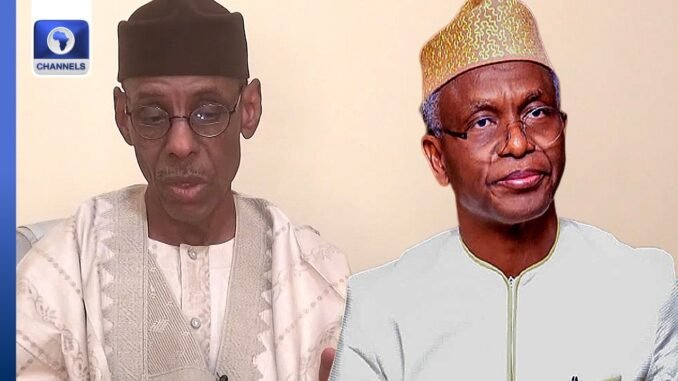

The Coalition Political Action Committee (COPAC), under the leadership of Aminu Datti-Ahmed, has issued a strong warning to the Federal Government: either release former Kaduna State governor Nasir El-Rufai immediately or bring formal charges against him in court.
The warning comes amid mounting concerns that keeping the former governor in custody beyond the approved 14-day remand period amounts to a clear violation of Nigeria’s Constitution.
Why This Matters Now
The 14-day remand order initially granted to investigators has now expired, and according to COPAC, the government must make a decision. The law is clear: you either charge the person to court or set them free. There’s no middle ground.
“This is not about El-Rufai. This is about ensuring that the law remains a level playing field. The rule of law must never become a selective weapon used against those who fall out of favour with those in power,” the group stated firmly.
What the Law Says
COPAC emphasized that the remand order was granted for a specific and limited purpose—to allow investigators complete their work within a defined timeframe. It was never intended as permission for indefinite detention or political gamesmanship.
Datti-Ahmed pointed to Section 35 of the Nigerian Constitution, which guarantees the liberty of every citizen. The law makes it abundantly clear: investigative detention must be temporary. After a reasonable period, authorities must either file formal charges in a competent court or release the detainee. No stories, no excuses.
“The Federal Government must now do one of two things: file formal charges before a competent court or release the detainee immediately,” COPAC declared.
A Call to Opposition Leaders
In a bold move, Datti-Ahmed also called on prominent opposition figures across party lines to break their silence. He specifically mentioned:
– Atiku Abubakar
– Peter Obi
– Aminu Tambuwal
– Rotimi Amaechi
– Rabiu Kwankwaso
According to COPAC, these leaders must speak out against what appears to be a coordinated attempt to intimidate opposition politicians using state machinery. The group warned that remaining silent at such a critical moment could be dangerous for democratic accountability in Nigeria.
International Law Also Violated
COPAC didn’t stop at citing Nigerian law. The group also pointed out that keeping El-Rufai beyond the legal remand period violates Nigeria’s obligations under international human rights frameworks, including:
– The International Covenant on Civil and Political Rights
– The African Charter on Human and Peoples’ Rights
Both international instruments clearly prohibit arbitrary arrest and detention—practices that undermine human dignity and democratic governance.
Beyond El-Rufai: A Threat to Democracy
While the immediate issue concerns the former Kaduna governor, COPAC warned that this case raises broader questions about the weaponization of state institutions in political battles.
The group expressed concern that if investigative powers can be deployed against political actors in ways that raise serious questions about selectivity, timing, and motive, Nigeria risks sliding toward authoritarianism.
“If the government has evidence, it should file charges. If it does not, it must release the detainee,” COPAC insisted. “The law is not optional. The Constitution is not a suggestion. Nigeria is a constitutional democracy, not a police state.”
The Bigger Picture
For many Nigerians watching this drama unfold, the El-Rufai case has become a test of the government’s commitment to constitutional rule. Will the Federal Government respect the law even when dealing with political opponents? Or will we continue to see a pattern where legal procedures are bent to suit political convenience?
As COPAC rightly noted, today it’s El-Rufai. Tomorrow, it could be anyone who finds themselves on the wrong side of those in power. That’s why protecting constitutional rights isn’t just about one individual—it’s about safeguarding democracy for all Nigerians.
What Happens Next?
All eyes are now on the Federal Government. The legal and constitutional path is clear. Nigerians are waiting to see whether the authorities will respect the rule of law or continue down a path that threatens the foundations of our democracy.
As the clock ticks, one thing remains certain: the Constitution is not negotiable, and the rights it guarantees must be protected for everyone, regardless of their political affiliation or past position.
The ball is firmly in the government’s court.
For more details, check buzzUp9ja
Be the first to comment