
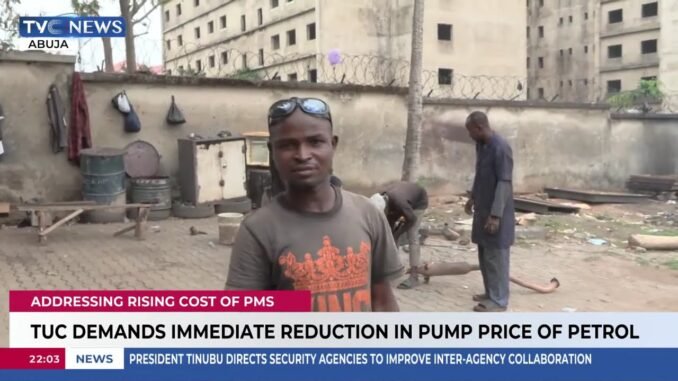

The Trade Union Congress of Nigeria (TUC) has sounded a serious alarm that Nigerians may soon be paying as much as N2,000 per litre for petrol if the Federal Government does not take immediate steps to address the current fuel pricing crisis.
This warning comes at a time when millions of Nigerians are already struggling with the high cost of living, with petrol prices having jumped significantly since the removal of fuel subsidy in May 2023.
TUC’s Bold Proposal: Subsidise Crude Feedstock
In a move that could provide much-needed relief to struggling Nigerians, the Trade Union Congress has called on the Federal Government to subsidise crude oil feedstock supplied to local refineries. This approach, according to the union, would help stabilize pump prices and prevent the dreaded N2,000 per litre scenario from becoming reality.
The TUC’s recommendation represents a middle-ground solution—rather than returning to the controversial full fuel subsidy regime, the government would instead subsidise the crude oil sold to Nigerian refineries, particularly the newly operational Dangote Refinery and the revamped Port Harcourt refinery.
Why This Matters Now
The timing of this warning cannot be ignored. With the naira continuing to face pressure against the dollar and global oil prices remaining volatile, the cost of importing refined petroleum products has become unbearable for ordinary Nigerians. Transport fares have skyrocketed, food prices have surged, and businesses are struggling to stay afloat.
For the average Nigerian family, petrol at N2,000 per litre would be nothing short of catastrophic. It would mean:
– Higher transport costs: Danfo and Keke fares would become unaffordable for many workers
– Increased food prices: As transportation costs rise, so will the price of food items in markets
– Business closures: Small businesses that depend on generators for power would face impossible operating costs
– Reduced purchasing power: Families would have even less money for basic necessities
The Crude-for-Naira Solution
The TUC’s proposal essentially asks the government to sell crude oil to local refineries at subsidized rates in naira, rather than at international market prices in dollars. This would allow refineries to produce petrol at lower costs, which would then translate to cheaper pump prices for Nigerians.
This approach has several potential benefits:
1. Supports local refining: It gives Nigerian refineries a competitive advantage and encourages domestic production
2. Reduces forex pressure: Less dependence on imported refined products means less demand for dollars
3. More targeted subsidy: Instead of subsidizing consumption (which benefits everyone including smugglers), this subsidizes production
4. Creates jobs: A thriving local refining sector means more employment opportunities for Nigerians
The Government’s Dilemma
The Federal Government finds itself between a rock and a hard place. On one hand, international financial institutions and economic advisers have long argued that fuel subsidy is unsustainable and economically harmful. On the other hand, the reality on ground shows that complete subsidy removal without adequate palliatives has caused severe hardship for ordinary Nigerians.
President Bola Tinubu’s administration has maintained that the subsidy removal was necessary to save Nigeria from economic collapse, as the country was spending trillions of naira annually on fuel subsidies. However, the promised palliatives and interventions have largely failed to reach those who need them most.
What Nigerians Are Saying
From Lagos to Kano, from Port Harcourt to Maiduguri, Nigerians are feeling the heat. Social media is filled with frustrations about the rising cost of living, and many are calling on the government to take urgent action.
“How can ordinary Nigerians survive if petrol reaches N2,000?” asked Chidi Okonkwo, a Lagos-based commercial driver. “Even at the current price, we are barely making ends meet. Something has to give.”
Market women in Onitsha, traders in Aba, and workers in Abuja all echo similar concerns. The fear is real, and the pressure on the government is mounting.
The Way Forward
As Nigeria navigates these challenging economic times, the TUC’s proposal deserves serious consideration. While it may not be a perfect solution, it offers a practical middle ground that could provide relief to millions of suffering Nigerians while still maintaining some market-oriented reforms.
The Federal Government must act quickly and decisively. Whether through subsidizing crude feedstock, implementing effective palliatives, or finding other creative solutions, action is needed now before petrol prices spiral completely out of control.
For ordinary Nigerians who are already pushed to the wall, the message is clear: we cannot afford to let fuel prices hit N2,000 per litre. The time for government intervention is now, not later.
What do you think about the TUC’s proposal? Should the government subsidize crude oil for local refineries? Share your thoughts in the comments below.
Stay updated for more details on buzzUp9ja
Be the first to comment