

The financial cost of America’s latest Middle East military adventure is mounting rapidly, with implications for global oil markets and regional stability
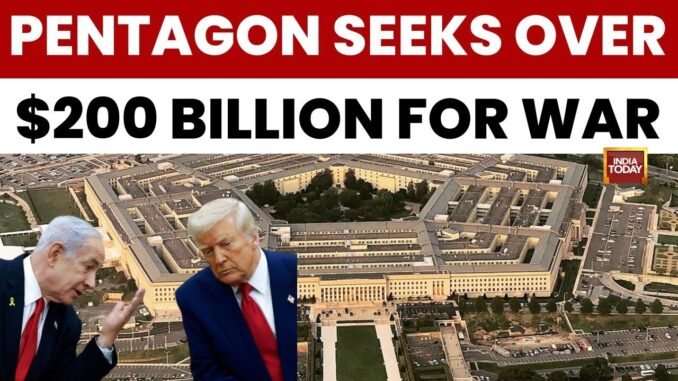
The United States Pentagon has made a staggering request to the White House for $200 billion in funding to continue military operations in Iran, according to multiple reports from Washington. This massive budget request comes as President Donald Trump considers deploying thousands more American soldiers to the volatile region.
The funding appeal follows a sobering analysis showing that the US has already burned through approximately $3.7 billion—that’s roughly $891.4 million per day—during just the first 100 hours of what military planners are calling “Operation Epic Fury.” By the end of the first week alone, expenditure had climbed to $11 billion.
For Nigerians watching from afar, these figures are eye-watering. To put it in perspective, $200 billion is more than Nigeria’s entire federal budget for 2024. The amount could fund massive infrastructure projects across Africa, yet it’s being requested for military operations in a conflict whose end remains uncertain.
Political Battle Lines Drawn in Washington
Multiple sources speaking to The Washington Post confirmed that Pentagon officials have formally asked the White House to seek congressional approval for the funding. However, whether President Trump will actually submit this request to lawmakers remains unclear.
The political arithmetic is challenging. Democrats in Congress have expressed strong opposition to the war efforts, and even some Republicans—notably Kentucky Senator Rand Paul, known for his libertarian stance on military spending—typically vote against such massive defence appropriations. This means securing the 60 votes needed to overcome a Senate filibuster could prove impossible.
Troop Deployment on the Table
Beyond the money, the Trump administration is actively considering a significant escalation of its military presence in the region. According to Reuters, citing US officials and sources familiar with the deliberations, thousands of additional American troops could soon be heading to the Middle East.
The conflict, now entering its third week, has prompted military planners to develop multiple operational scenarios. Chief among them is securing safe passage for oil tankers through the strategic Strait of Hormuz—a narrow waterway that serves as a critical chokepoint for global oil supplies.
For Nigeria and other oil-producing nations, the security of this strait matters enormously. Roughly one-fifth of the world’s petroleum passes through this 21-mile-wide channel. Any disruption here reverberates through global energy markets, affecting prices from Lagos to London.
High-Risk Operations Under Consideration
The most ambitious—and dangerous—options being discussed include deploying US troops directly to Iranian territory. Sources told Reuters that American forces could be stationed along Iran’s shoreline to ensure the Strait remains open.
Even more dramatically, US officials have discussed the possibility of seizing Kharg Island, the nerve centre of Iran’s oil infrastructure. This tiny island handles approximately 90 percent of Iran’s oil exports, making it both strategically vital and heavily defended.
Military experts have warned that such an operation would be extraordinarily risky. Iran possesses sophisticated missile and drone capabilities that could easily reach the island, potentially leading to significant American casualties.
What This Means for Global Oil Markets
The escalating conflict carries serious implications for oil-dependent economies like Nigeria’s. Any disruption to Iranian oil exports—or worse, a closure of the Strait of Hormuz—would send global crude prices soaring.
Nigeria, despite being an oil producer, is paradoxically vulnerable to such price spikes due to its heavy reliance on imported refined petroleum products. Higher global prices would translate directly to increased costs at Nigerian fuel stations, with knock-on effects throughout the economy.
The Road Ahead
As this situation develops, several questions remain unanswered: Will Congress approve such massive military spending? Can the Trump administration build sufficient political support for an expanded ground operation? And perhaps most critically, what is the endgame for American involvement in Iran?
For now, the world watches as the United States contemplates its next moves in a conflict that has already proven expensive in both financial and human terms—with the potential to become far more costly still.
This is a developing story. Further updates will be provided as more information becomes available.
Stay updated for more details on buzzUp9ja
Be the first to comment