
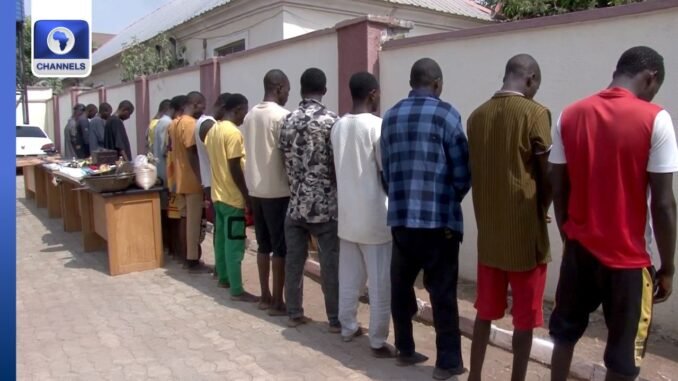

A 30-year-old man has been arrested for allegedly defrauding a car dealer using fabricated bank transfer alert in what security operatives describe as a brazen case of cybercrime and attempted theft.
The Nigeria Security and Civil Defence Corps (NSCDC) Bauchi State Command has apprehended Hanif Muhammed Umar and his accomplice, Sani Abdullahi, for their alleged involvement in a sophisticated fraud scheme that almost cost a Kano-based businessman a Mercedes-Benz C.300 4matic worth N7 million.
The arrest, announced by the command’s Public Relations Officer, Saminu Yusuf, on Sunday, March 8, 2026, has sent shockwaves through the online business community, highlighting the growing menace of fake transfer alerts in commercial transactions.
The Elaborate Scam
According to NSCDC’s statement, the fraud unfolded when Fahad Kasko, a car dealer from Kano, sent his driver, Gambo Suleiman, to deliver the unregistered grey Mercedes-Benz to Azare in Katagum Local Government Area of Bauchi State for sale.
Umar, displaying the confidence typical of experienced fraudsters, allegedly orchestrated what appeared to be a seamless transaction. He purportedly generated a fake credit alert from his Opay bank account showing a payment of N7 million—the full price of the luxury vehicle.
“Preliminary investigation revealed that the car owner Mr Fahad Kasko sent his driver Mr Gambo Suleiman of Obasanjo road Kano to deliver the car at Azare, Katagum LGA of Bauchi state for sale, where the suspect made fake credit alert transaction from his Opay bank account to the tune of N7,000,000 (Seven million naira) as payment for the car and immediately drove the car away,” Yusuf explained.
Once the fake alert was shown, Umar wasted no time. He quickly took possession of the vehicle and drove off—but his freedom was short-lived.
Swift Justice
When Kasko discovered the fraudulent transaction, he immediately contacted the NSCDC. The security agency sprang into action with impressive speed and efficiency.
On February 22, 2026, barely hours after the scam was reported, NSCDC personnel arrested both Umar and his 25-year-old accomplice, Abdullahi, at a checkpoint in Misau Local Government Area.
The suspects were found with the Mercedes-Benz, and the vehicle was recovered on the spot.
“At the discovery of the fake credit alert, the complainant Mr Fahad Kasko alerted the NSCDC personnel who swung into action and arrested the suspects in company of his accomplice at the checkpoint,” the statement confirmed.
Charges and Warning
The duo now faces serious charges including criminal conspiracy, cybercrime, and attempted theft—offences that carry substantial prison sentences under Nigerian law.
Speaking to journalists, Yusuf emphasized that the Bauchi State NSCDC command, under the leadership of Commandant CC. Oloyede Nelson Oyerinde, remains committed to ridding the state of criminal activities.
He issued a stern warning to young Nigerians tempted by the get-rich-quick schemes that have become increasingly common in the digital age.
“The command public relation officer while addressing the gentlemen of the press emphasised that the command under the leadership of CC. Oloyede Nelson Oyerinde, resolved to get rid of crime in the state. He also warned the youth to desist from criminal conspiracy, cyber crime and all forms of fraudulent acts that can lead them to imprisonment,” the statement read.
Growing Menace of Fake Alerts
This incident reflects a disturbing trend across Nigeria, where fraudsters exploit digital payment platforms to deceive unsuspecting sellers. Fake bank alerts have become a common tool for scammers targeting high-value transactions such as cars, electronics, and real estate.
Security experts advise traders and business owners to always confirm payments directly with their banks before releasing goods, regardless of how convincing transfer alerts may appear on their phones.
The NSCDC’s swift response in this case serves as both a warning to potential criminals and reassurance to law-abiding citizens that security agencies are actively combating cybercrime across the country.
As investigations continue, the suspects remain in custody and will be prosecuted according to the full extent of the law.
Have you or someone you know been a victim of fake alert fraud? Share your experience in the comments below and help others stay vigilant.
For more details, check buzzUp9ja
Be the first to comment