
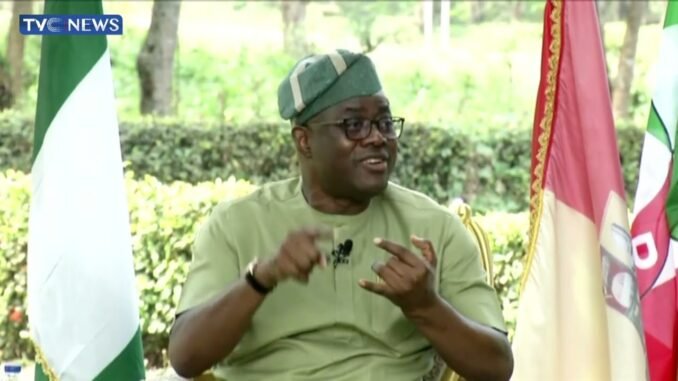

Governor Seyi Makinde of Oyo State has raised serious concerns about the health of Nigeria’s democracy, warning that our beloved country may be slowly but surely sliding into a dangerous one-party state system.
The Peoples Democratic Party (PDP) governor, known for his frank assessments of national issues, shared these troubling observations in a recent newsletter that has since sparked important conversations across the political landscape.
The Warning Signs We Cannot Ignore
In his newsletter titled “The Bus,” Governor Makinde didn’t mince words about what he sees happening to our democratic institutions. According to him, the signs are clear for those willing to see them—Nigeria’s multi-party democracy, which we fought so hard to establish and maintain, is being threatened by the growing dominance of a single political party.
This is not the first time concerns have been raised about the state of our democracy. Since 1999, when we returned to civilian rule after years of military governance, Nigerians have jealously guarded our democratic rights. However, recent political developments have made many wonder if we’re truly progressing or regressing.
Why This Matters to Every Nigerian
For those who may not immediately grasp the gravity of this situation, let’s break it down in simple terms. A one-party state is a political system where only one party holds power, effectively shutting out opposition voices and alternative viewpoints. This is the opposite of the robust democracy we claim to practice.
In a healthy democracy, opposition parties serve as checks and balances, ensuring that the ruling party remains accountable to the people. They provide alternative policies, challenge questionable decisions, and give citizens real choices during elections.
When one party becomes too dominant, several things happen:
– Accountability disappears: Without strong opposition, there’s no one to question the government’s actions effectively
– Corruption flourishes: When power is concentrated without meaningful checks, it becomes easier for bad actors to exploit the system
– Citizens lose their voice: With fewer genuine alternatives, voters feel their choices don’t matter
– Innovation stagnates: Competition between parties drives better policies; without it, governance becomes complacent
The Current Political Reality
Governor Makinde’s concerns come at a time when many Nigerians are already feeling frustrated with the political system. The ruling All Progressives Congress (APC) currently controls the federal government and a significant majority of state governments across the federation.
While electoral victory is legitimate in democracy, the manner in which power is consolidated and wielded matters greatly. The governor’s warning appears to reference not just electoral dominance, but the systematic weakening of democratic institutions and opposition voices.
What Nigerians Are Saying
The reactions to Makinde’s statement have been mixed but largely concerned. On social media, in beer parlours, and in political gatherings across Nigeria, citizens are debating what this means for our collective future.
Some Nigerians argue that the governor is simply being a sore loser, unable to accept that his party lost national power. Others, however, see his warning as a patriotic call to action—a reminder that democracy requires constant vigilance and participation from all stakeholders.
Lessons from History
Those familiar with Nigeria’s political history will remember that we’ve flirted with one-party dominance before. During the First Republic, regional parties dominated their territories almost absolutely. During military rule, we had no parties at all—just decrees and edicts.
We’ve also seen what happens in other African countries when one party becomes too powerful. From Zimbabwe to Uganda to Cameroon, the story is often the same: democratic institutions weaken, freedoms shrink, and citizens suffer.
The Role of Opposition Politics
Governor Makinde himself represents something important in Nigerian politics—a state governor from an opposition party who has maintained his position despite immense pressure. His administration in Oyo State has been watched closely as a test case for opposition governance in Nigeria.
His concerns, therefore, aren’t just theoretical. They come from someone actively experiencing the challenges of operating as opposition in today’s Nigeria.
What Can Be Done?
The question on everyone’s mind is: what do we do about this? How do we strengthen our democracy and ensure that Nigeria doesn’t drift into one-party dominance?
For Citizens:
– Stay politically aware and engaged
– Don’t sell your votes for rice or money
– Hold all politicians accountable, regardless of party
– Support institutional reforms that strengthen democracy
For Political Parties:
– Opposition parties must unite around shared democratic values
– Focus on issue-based politics rather than personal attacks
– Build strong grassroots structures
– Offer genuine alternatives to voters
For Democratic Institutions:
– INEC must ensure truly free and fair elections
– The judiciary must remain independent
– Security agencies should remain neutral
– Media must report without fear or favor
The Bigger Picture
Governor Makinde’s warning is ultimately about more than party politics. It’s about the kind of country we want to leave for our children. It’s about whether Nigeria will truly be a democracy or just maintain the appearance of one.
Democracy isn’t just about voting every four years. It’s about the daily practice of freedom, accountability, and citizen participation. It’s about having real choices and knowing that those choices matter.
Moving Forward
As Nigeria continues to navigate its democratic journey, voices like Governor Makinde’s serve an important purpose. Whether you agree with him politically or not, his concerns deserve serious consideration and honest debate.
The health of our democracy depends on all of us—not just politicians, but every Nigerian who cares about the future of this nation. We must remain vigilant, engaged, and committed to the democratic principles that have cost so much to establish.
The question isn’t whether we have challenges—we clearly do. The question is whether we have the collective will to address them before it’s too late.
What do you think about Governor Makinde’s concerns? Is Nigeria truly drifting toward a one-party state, or are these just the complaints of an opposition politician? Share your thoughts in the comments below.
This is a developing story. Stay tuned for more updates on Nigerian politics and democracy.
For more information, check buzzUp9ja
Be the first to comment