
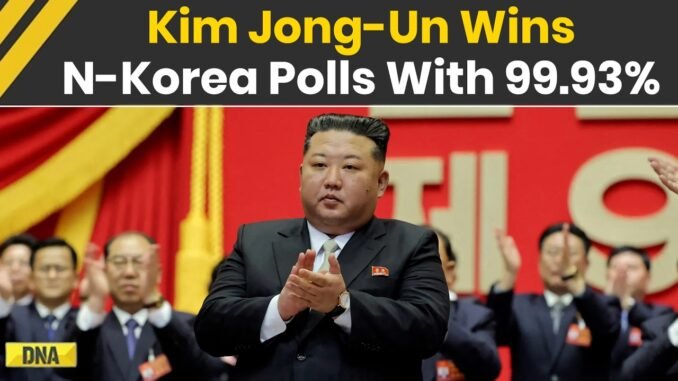

Summary: North Korean dictator Kim Jong Un secures another landslide victory with 99.93% of votes in an election where citizens had no real choice. Here’s what this means for the isolated nation.
The North Korean regime has once again staged what critics worldwide are calling a “rubber-stamp election,” with dictator Kim Jong Un’s ruling party claiming an astonishing 99.93 per cent of the vote. If you’re thinking that sounds fishy, you’re not alone—the entire international community is raising eyebrows at yet another exercise in political theatre from the hermit kingdom.
An Election in Name Only
According to reports from Yonhap News Agency, the ruling Workers’ Party of Korea and its allies swept all 687 seats in the Supreme People’s Assembly (SPA) during the March 15 vote. But here’s the catch: North Koreans didn’t really have a choice.
Every citizen over 17 years old was handed a ballot with a single candidate—pre-selected by Kim’s party—and given a simple “yes or no” option. Unsurprisingly, 99.93% voted “yes,” with only 0.07% brave (or perhaps reckless) enough to vote against. The reported turnout? A mind-boggling 99.99%.
For those familiar with Nigeria’s own electoral struggles and the push for credible elections, the North Korean system represents democracy’s complete opposite. Imagine INEC announcing that one party won 100% of all seats nationwide with no opposition—that’s essentially what happens in North Korea, election after election.
Major Shake-Up in Leadership
What makes this particular sham election noteworthy is the scale of internal changes. Over 70% of the deputies are new faces, signaling a massive political restructuring. Experts believe Kim is using this reshuffle to remove old power centres and install loyalists who owe their positions directly to him.
Veteran leader Choe Ryong-hae, once considered part of the inner circle, has been shown the exit door—a clear warning that no one is truly safe in Kim’s North Korea. Meanwhile, close aide Jo Yong-won is expected to take a top parliamentary role.
Kim’s younger sister, Kim Yo-jong, who has become increasingly prominent in recent years, is among the newly elected deputies. Foreign Minister Choe Son-hui also secured a seat, further consolidating the power of Kim’s trusted inner circle.
What Comes Next?
The Supreme People’s Assembly will soon convene in Pyongyang, where lawmakers are expected to formally reappoint Kim as head of the State Affairs Commission—essentially rubber-stamping his continued grip on absolute power.
More significantly, the assembly may revise North Korea’s constitution to redefine relations with South Korea. Observers suggest that Pyongyang could formally declare the South a hostile state, marking a dangerous shift in inter-Korean relations.
Kim has also pledged to make his nation “less backwards”—though how he plans to achieve this while maintaining totalitarian control and international isolation remains unclear.
The Bigger Picture
While many Nigerians grapple with ensuring free and fair elections, North Korea serves as a stark reminder of what happens when democratic principles are completely abandoned. The country’s “elections” are nothing more than staged events designed to give a veneer of legitimacy to an authoritarian regime.
As North Korea continues its isolation from the global community, its citizens remain trapped in a system where political participation means nodding in agreement—or facing potentially severe consequences.
For now, Kim Jong Un remains firmly in control, surrounded by loyalists and family members, ruling over one of the world’s most closed-off nations with an iron fist disguised as a “people’s democracy.”
Stay updated for more details on buzzUp9ja
Be the first to comment