
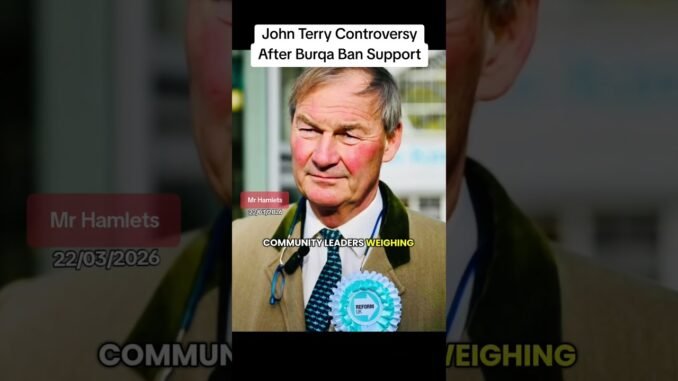

Summary: Former Chelsea and England captain John Terry has generated heated debate after appearing to endorse a controversial proposal to ban the burqa in British public spaces.
English football legend John Terry has found himself at the centre of a social media storm after seemingly backing a divisive policy to ban the burqa across the United Kingdom.
The former Chelsea FC and England national team captain raised eyebrows when he responded to an Instagram post by Rupert Lowe, leader of the Restore Britain party. Terry’s reaction—three clapping emojis—has been widely interpreted as showing support for Lowe’s controversial stance.
What Did the Post Say?
Lowe’s Instagram post outlined several policy proposals, including:
– A complete ban on wearing burqas in British public spaces
– A requirement for all signage at transport hubs and public facilities to be displayed in English only
The post featured a photograph of a woman wearing a burqa outside Whitechapel Station in London, alongside Bengali-language signage that serves the area’s significant Bangladeshi population.
The Backlash and Defence
The apparent endorsement quickly attracted criticism from various quarters, with many questioning whether a public figure of Terry’s stature should be supporting such polarizing positions.
In response to the controversy, Rupert Lowe defended the former footballer, arguing that Terry was being unfairly targeted for expressing a view that, according to Lowe, reflects the opinion of many British citizens.
A Familiar European Debate
The question of whether to ban religious face coverings is not new to Europe. France has already implemented strict restrictions on wearing the burqa and niqab in public spaces, citing its commitment to secularism (laïcité). Similar debates have emerged across several European nations.
In the UK, the issue has periodically resurfaced in political discourse, with recent discussions involving members of Reform UK and other political groups. However, opinion remains sharply divided both within political circles and among the general public.
Terry’s Silence
As of now, John Terry has not publicly clarified his position on the matter or provided any additional context for his social media reaction. His representatives have also declined to issue a formal statement addressing the controversy.
The incident highlights how social media interactions by high-profile figures—even something as seemingly simple as emoji reactions—can quickly escalate into major public debates, particularly when touching on sensitive issues of religion, culture, and identity.
What do you think? Should public figures be more cautious about their social media interactions on controversial topics? Share your thoughts in the comments below.
Visit buzzUp9ja for more updates
Be the first to comment