
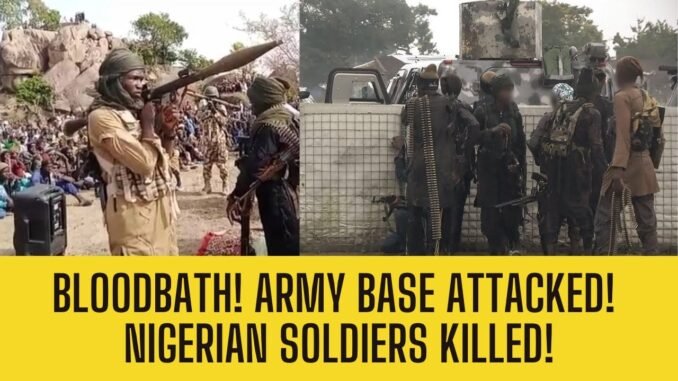

At least 14 people, including 10 Nigerian soldiers, have been killed in a series of coordinated attacks by jihadist fighters across military installations in the Northeast, raising fresh concerns about the resilience of insurgent groups in the region.
Militant fighters from Boko Haram and the Islamic State West Africa Province (ISWAP) carried out separate but synchronized raids on military bases in Borno and Yobe States on Monday, targeting the heart of Nigeria’s counter-insurgency operations.
According to military and civilian sources, the attacks represent a troubling escalation in violence against security forces, even as overall insurgency-related violence has decreased from its peak levels ten years ago.
Multiple Fronts Under Siege
The most severe assault occurred in Kukawa town, located in the Lake Chad basin area of Borno State. ISWAP fighters launched an overnight raid on a military base, killing four troops, including a senior military commander.
Ali Kaka, a member of the Civilian Joint Task Force (CJTF) — local vigilantes who support the Nigerian Army — described a fierce gun battle that lasted approximately three hours. “We lost three soldiers and one of our militia members,” Kaka confirmed, highlighting the intensity of the confrontation.
In Borno’s Konduga Local Government Area, suspected Boko Haram militants attacked the community of Dalwa with devastating consequences. Local chief Shettima Isa Bukar reported that the attackers killed two soldiers and four civilians before setting ablaze more than 200 homes. The destruction has left many families displaced and mourning their losses.
Yobe State Also Targeted
The violence extended beyond Borno to neighbouring Yobe State, where suspected Boko Haram fighters raided a military base in Goniri town. Manu Ibrahim, a resident of nearby Katarko, reported that four soldiers lost their lives in the attack. The militants also torched several military buildings and vehicles before withdrawing.
Lieutenant-Colonel Sani Uba, a military spokesperson in the Northeast, confirmed the casualties while commending the troops for their bravery. “Despite the coordinated nature of these assaults, our troops showed remarkable courage in defending their positions. All affected locations remain firmly under government control,” he stated.
A Conflict That Won’t End
The Northeast insurgency, which began over 16 years ago, continues to exact a heavy toll on Nigeria. Boko Haram and its splinter group ISWAP seek to establish an Islamist caliphate in the region, and their campaign has resulted in more than 40,000 deaths and displaced approximately two million people.
Just last week, another brutal attack in Ngoshe, Gwoza Local Government Area near the Cameroon border, claimed the lives of seven soldiers and 11 civilians when Boko Haram fighters stormed a military base and surrounding communities.
International Support Arrives
In response to the persistent threat, the United States began deploying troops to Nigeria in February to provide technical and training support to the Nigerian military. This deployment came amid international attention on security challenges in the Northeast.
The American deployment followed allegations raised in the United States about attacks specifically targeting Christians in Nigeria. However, both the Nigerian government and independent security analysts have firmly rejected these claims, emphasizing that the jihadist violence affects both Christians and Muslims indiscriminately.
The Road Ahead
While Monday’s attacks have been repelled and all military positions remain under government control, the coordinated nature of the assaults demonstrates that both Boko Haram and ISWAP retain significant operational capability.
For the communities of Borno and Yobe States, the dream of lasting peace remains elusive. As families in Dalwa mourn their dead and survey the ashes of their homes, and as the military buries its fallen heroes, Nigeria’s battle against jihadist insurgency continues with no clear end in sight.
The resilience of these militant groups, despite years of military operations and billions spent on security, poses fundamental questions about the strategy needed to finally bring peace to Nigeria’s troubled Northeast.
This developing story will be updated as more information becomes available.
Check buzzUp9ja for more details
Be the first to comment