
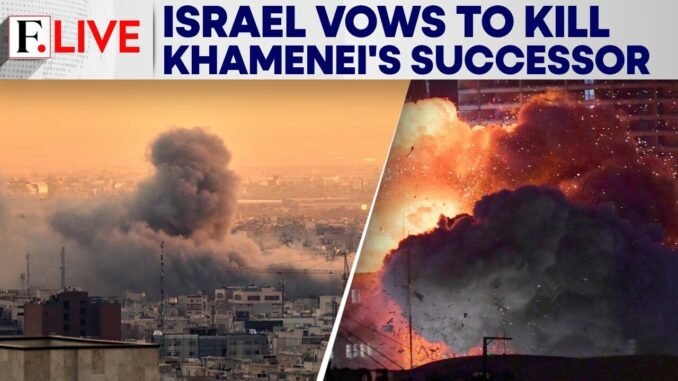

Summary: Israeli Defense Minister Israel Katz has declared that any successor to Iran’s Supreme Leader Ali Khamenei will be targeted for assassination, following reports of joint US-Israeli airstrikes on Tehran.
The tension between Israel and Iran has escalated to unprecedented levels as Israeli Defense Minister, Israel Katz, issued a chilling warning on Wednesday, March 4. According to Katz, any Iranian leader chosen to succeed Supreme Leader Ali Khamenei will automatically become a target for assassination.
This bold statement came after unconfirmed reports suggested that Khamenei may have been killed during coordinated airstrikes by American and Israeli forces on Tehran. If true, this development would mark a significant turning point in Middle Eastern politics and international relations.
“No Matter His Name or Where He Hides”
Taking to X (formerly Twitter), Katz made his position crystal clear in both Hebrew and English. “Any leader selected by the Iranian terror regime to continue leading the plan for Israel’s destruction, threatening the United States, the free world and countries in the region, and suppressing the Iranian people, will be a certain target for assassination, no matter his name or where he hides,” he declared.
The statement reflects the deep-seated animosity between the two nations—a conflict that has only intensified over the past twenty years. For Nigerians following global affairs, this situation mirrors the kind of regional power struggles we’ve witnessed across Africa, though with far more dangerous implications given the nuclear dimensions involved.
Understanding the Israel-Iran Conflict
For those unfamiliar with the background, the Israeli-Iranian rivalry runs deep. Iran’s leadership, especially under Khamenei’s decades-long rule, has consistently refused to recognize Israel as a legitimate state. Instead, Tehran has provided substantial support to armed groups like Hezbollah in Lebanon and Hamas in Gaza—both considered terrorist organizations by Israel and its Western allies.
Israel, on its part, has accused Iran of pursuing nuclear weapons development, a charge Tehran denies. Over the years, Israeli intelligence services have conducted numerous covert operations aimed at sabotaging Iran’s nuclear program and military infrastructure.
Who Was Ali Khamenei?
Ali Khamenei became Iran’s Supreme Leader in 1989 following the death of Ayatollah Ruhollah Khomeini, the founder of the Islamic Republic. As Supreme Leader, Khamenei held absolute authority over Iran’s military, judiciary, and major state institutions. His position made him the most powerful figure in Iranian politics—more influential than even the country’s elected president.
If reports of his death are confirmed, it would represent one of the most dramatic shifts in Middle Eastern geopolitics in recent memory. Think of it as comparable to the sudden removal of a figure who has shaped an entire region’s politics for over three decades.
What This Means for Regional Stability
Katz’s threat suggests that Israel has no intention of softening its approach, regardless of who assumes leadership in Tehran. The Israeli government appears committed to a hardline security strategy that views Iran’s entire political establishment as an existential threat.
Recent joint US-Israeli strikes reportedly targeted critical Iranian military and nuclear facilities in and around Tehran, representing a dramatic escalation from the “shadow conflict” that has characterized relations between these nations for years.
The Bigger Picture
For Nigeria and other African nations watching these developments, the implications extend beyond the Middle East. Oil prices, global security dynamics, and international diplomatic alignments could all be affected by further escalation in this conflict.
Iran is a significant oil producer, and any prolonged military confrontation could disrupt global energy markets—something that would directly impact Nigeria’s economy and those of our neighbors.
As this situation continues to unfold, the world watches with concern. The possibility of a leadership transition in Iran amid military strikes raises questions about regional stability, international law, and the future of Middle Eastern politics.
What remains clear is that Israel has drawn a hard line: it will not accept any Iranian leadership that continues what it perceives as Tehran’s aggressive anti-Israel agenda.
—
This is a developing story. Further updates will be provided as more information becomes available on buzzUp9ja
Be the first to comment