
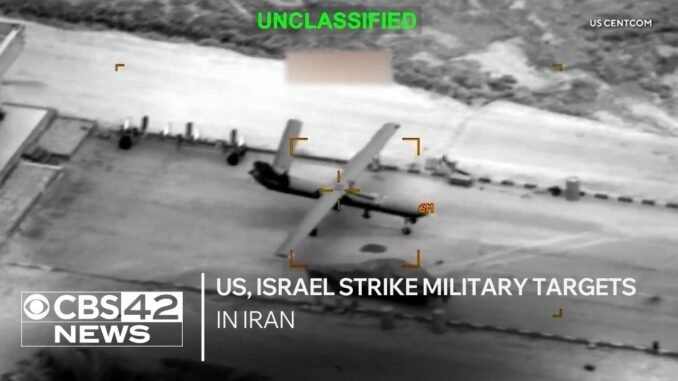

Summary: Iran’s state television confirms the deaths of its defense minister, armed forces chief, and other senior military officials following joint US-Israeli airstrikes that have shaken the Middle East.
—
In a development that has sent shockwaves across the Middle East and beyond, Iran’s state television confirmed on Sunday that the country’s armed forces chief of staff, Abdolrahim Mousavi, was killed alongside several other senior military officials in coordinated strikes by the United States and Israel.
According to the state broadcaster, the attack claimed the lives of Defense Minister Aziz Nasirzadeh, Revolutionary Guards chief Mohammad Pakpour, and Ali Shamkhani, head of the defense council. The officials were reportedly killed “during a Defense Council meeting” on Saturday, with authorities indicating that additional names would be released as investigations continue.
A Bold Pre-emptive Strike
The Israeli government announced on Saturday that it had launched what it described as a “pre-emptive attack” against Iran, aimed at neutralizing threats from Tehran’s nuclear and missile programmes. The operation, which reportedly involved close coordination with American forces, targeted multiple sites across Iranian territory.
The strikes represent a significant escalation in the long-standing tensions between Israel and Iran, with both nations having engaged in a shadow war for years through proxies and covert operations. However, this direct military action marks a dramatic shift in approach.
Reactions and Celebrations
Reports have emerged of celebrations among some Iranians, both within the country and in diaspora communities worldwide, following unconfirmed claims that Supreme Leader Ayatollah Ali Khamenei was also killed in the strikes. While these reports remain unverified, they highlight the deep divisions within Iranian society regarding the current regime.
Regional Tensions Escalate
As news of the strikes spread, sirens sounded across Israel amid fears of potential Iranian retaliation. Explosions were widely reported in Tehran, with Iranian media confirming significant military activity in the capital and other strategic locations.
The international community is watching closely, with concerns mounting about the potential for a broader regional conflict. Nigeria, like many other nations, maintains diplomatic and economic ties with Iran, particularly in the oil and gas sector, and any prolonged instability in the region could have ripple effects on global energy markets.
Diplomatic Fallout
The military operation has effectively demolished recent diplomatic efforts aimed at reviving negotiations between Washington and Tehran over Iran’s nuclear programme. The talks, which had shown modest progress in recent months, were seen as a potential pathway to reducing tensions and preventing further military escalation.
Analysts note that this dramatic turn of events could reshape the geopolitical landscape of the Middle East for years to come, with implications for international security, energy markets, and diplomatic relations across the globe.
What Happens Next?
As the dust settles, questions remain about Iran’s response and the potential for further military action. The loss of such senior military leadership represents a significant blow to Iran’s command structure, but it may also fuel desires for retaliation among hardliners within the regime.
For now, the world waits to see how this crisis unfolds, with hopes that diplomatic channels can still prevent a full-scale regional war.
—
This is a developing story. Updates will be provided as more information becomes available.
For more details, read more on buzzUp9ja.
Be the first to comment