
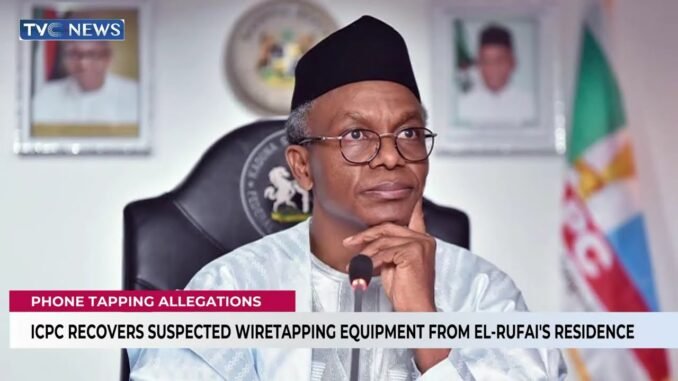

Summary: The ICPC has recovered alleged wiretapping devices from former Kaduna governor Nasir El-Rufai’s home, alongside sensitive security documents. The anti-graft agency reveals shocking details of corruption allegations totaling billions of naira.
The Independent Corrupt Practices and Other Related Offences Commission (ICPC) has made a stunning revelation that it recovered suspected wiretapping equipment allegedly capable of intercepting private conversations and accessing sensitive security documents from the Abuja home of former Kaduna State governor, Nasir El-Rufai.
This bombshell disclosure was made in court filings by the anti-graft agency, painting a picture of allegations that go beyond ordinary corruption cases Nigerian have become accustomed to.
What Was Found During the Search?
According to the ICPC, operatives conducted a thorough search at El-Rufai’s residence at No. 12 Mambila Street, Aso Drive, Asokoro District, Abuja, on February 19, 2026. The search, which was witnessed by his wife, Hadiza El-Rufai, and his son, Hon. Mohammed Bello El-Rufai, yielded items that have raised serious national security concerns.
The commission claimed it recovered:
– Electronic magnetic equipment allegedly capable of tapping conversations
– Sensitive security documents from various government security agencies
– Documents described as “capable of compromising national security”
What makes this case particularly interesting is that El-Rufai had previously admitted on national television to tapping the telephone conversations of the National Security Adviser, Mallam Nuhu Ribadu. This admission now appears to have come back to haunt the former governor.
The Money Questions: Billions Under Investigation
Beyond the wiretapping allegations, ICPC has outlined serious corruption allegations that El-Rufai must answer. The figures involved are staggering by any standard:
– €1.4 million whose whereabouts remain unknown
– 180 suspicious payments* totaling *N2,158,799,199 from a Consolidated Revenue Account linked to Kaduna State’s Internally Generated Revenue (IGR) account
– Transfers to undisclosed accounts amounting to N428,122,180.18
For context, these are not small amounts we’re talking about here. In a country where many states struggle to pay workers’ salaries, such figures raise serious questions about accountability during El-Rufai’s eight-year tenure as Kaduna governor.
The Legal Battle: Detention and Rights Violation Claims
El-Rufai has filed a fundamental human rights enforcement suit, alleging unlawful detention and violation of his rights. However, the ICPC is having none of it.
In an affidavit deposed by David Efuk, a Litigation Officer, the commission insisted that everything was done according to the law. They obtained a remand order from a Magistrate Court in Bwari, FCT, on February 19, 2026, giving them 14 days to detain the former governor. This order is set to expire on Thursday, March 5.
The ICPC fired back at El-Rufai’s claims, stating: “Contrary to the depositions of the applicant in his supporting affidavit, he is lawfully held in the custody of the commission, and the commission has not breached any of his fundamental rights as claimed.”
Refusal to Cooperate
One of the most damaging aspects of the ICPC’s case against El-Rufai is the allegation that he has refused to cooperate with investigators. According to the commission, despite being confronted with retrieved documents during preliminary investigation activities, the former governor has “refused to respond to interviews to date.”
The agency also claimed that when asked to give consent to enable them access the alleged wiretapping equipment, El-Rufai refused. This non-cooperation, the ICPC argues, necessitates his continued detention until investigations are concluded.
The Bigger Picture: Witness Intimidation Allegations
As if the case wasn’t complicated enough, the ICPC has alleged that El-Rufai is threatening potential prosecution witnesses. According to the commission, one such witness has written seeking protection, and an aide linked to the investigation has already fled the country.
This paints a picture of a man allegedly using his influence and connections to frustrate investigations—a common narrative in Nigerian corruption cases but one that often proves difficult to substantiate in court.
How Did We Get Here?
The journey to this point has been dramatic. The ICPC claims it made several attempts to invite El-Rufai formally through letters, all of which proved unsuccessful. On February 5, 2026, when the commission received information about his arrival at Nnamdi Azikiwe International Airport, Abuja, they contacted DSS operatives to assist in arresting him, but that attempt failed.
Eventually, they located his residence and formally served him with an invitation letter to appear on February 13, 2026. Through his lawyers, he requested to honour the invitation on February 18 instead. However, before that date, he had already been detained by the Economic and Financial Crimes Commission (EFCC) on separate matters.
After being granted administrative bail by the EFCC but failing to meet the conditions, he was handed over to the DSS and subsequently to the ICPC on February 18, 2026, at about 7 pm.
What Happens Next?
The ICPC has promised to draw up formal charges against El-Rufai before March 5, 2026, when the current detention order expires. The commission is asking the FCT High Court to dismiss his fundamental rights suit, arguing that it lacks merit and that they should be allowed to investigate the allegations thoroughly in the public interest.
For Nigerians watching this case unfold, it represents yet another test of whether the anti-corruption fight in the country can successfully prosecute high-profile individuals regardless of their political connections and influence.
El-Rufai, known for his combative style and strong opinions during his time as governor and earlier as FCT minister, now finds himself on the defensive, facing allegations that touch on both corruption and national security.
As the March 5 deadline approaches, all eyes will be on the ICPC to see if they can substantiate these serious allegations with credible charges. For a nation tired of corruption scandals that often end in nothing, this case could set an important precedent—or become another disappointing chapter in Nigeria’s anti-corruption story.
The coming days will tell.
BuzzUp9ja has more details for you
Be the first to comment