
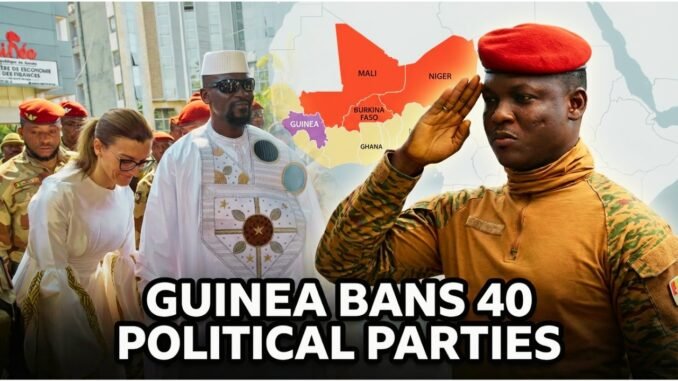

In a move that has sent shockwaves across West Africa, Guinea’s government has dissolved 40 political parties, including the country’s three heavyweight opposition groups, barely two months after President Mamady Doumbouya took the oath of office.
The controversial decree, issued late at night by the Ministry of Territorial Administration and Decentralisation, cited “failure to fulfil their obligations” as the reason for the mass dissolution. But political observers across the region are reading between the lines, seeing this as another chapter in Guinea’s long struggle with democratic governance.
What the Decree Means
The government’s order doesn’t just ban these parties from operating—it strips them of everything. Their legal status? Gone. Their assets? Seized. Their right to use their names, logos, and symbols? Cancelled immediately.
“This dissolution entails the immediate loss of the legal personality and status of the parties concerned,” the decree stated in unambiguous terms.
The affected parties’ properties have been placed under sequestration, with government-appointed curators now in charge. However, the decree remains silent on who will ultimately control these assets—a detail that has raised eyebrows among legal experts and civil society groups.
The Big Players Affected
Among the 40 dissolved parties are Guinea’s political heavyweights:
– Union of Democratic Forces of Guinea (UFDG), led by veteran opposition figure Cellou Dalein Diallo
– Rally of the People of Guinea (RPG), associated with former President Alpha Condé
– Union of Republican Forces (UFR)
These parties have been the backbone of political opposition in Guinea for years, representing millions of Guineans who oppose the current government.
The Man Behind the Move
President Mamady Doumbouya, just 41 years old, is no stranger to controversial decisions. The former military officer first seized power in a 2021 coup that toppled Alpha Condé, who ironically was Guinea’s first democratically elected president.
Doumbouya’s journey from coup leader to elected president came through a December election that was anything but smooth. Major opposition figures were barred from participating, and international observers raised serious questions about the vote’s credibility.
A Disturbing Pattern
Since taking control, Doumbouya’s government has developed a reputation for tightening its grip on power. The pattern is familiar to many Nigerians who have watched similar scenarios unfold across West Africa:
– Protest bans: Citizens can no longer freely demonstrate against government policies
– Arrests and trials: Opposition figures face prosecution, often on charges critics call politically motivated
– Forced exile: Some politicians have fled the country to avoid detention
– Alleged disappearances: Human rights organizations have documented cases of enforced disappearances and kidnappings
A Troubled History
For those following Guinea’s political journey, this latest development is depressingly familiar. Since breaking free from French colonial rule in 1958, Guinea has lurched from one military regime to another, with brief interludes of civilian rule.
The country’s democratic experiment has been fragile at best, and many are now questioning whether it has completely collapsed under Doumbouya’s watch.
What This Means for West Africa
Guinea’s political crisis doesn’t exist in isolation. West Africa has witnessed a disturbing wave of military takeovers in recent years—from Mali to Burkina Faso to Niger. Guinea’s regression adds to regional concerns about democratic backsliding.
For Nigeria and other ECOWAS member states, Guinea’s situation presents both a warning and a challenge. The region’s stability depends on democratic governance, and each country that slides toward authoritarianism weakens the entire neighborhood.
As the dust settles on this midnight decree, one thing is clear: Guinea’s path to democracy has hit another major roadblock, and the country’s citizens are once again left wondering when they’ll truly have a say in how they’re governed.
The dissolution of these parties raises important questions about political freedom and democratic governance in West Africa. As the situation develops, regional bodies like ECOWAS will need to decide how—or whether—to respond to yet another democratic setback in the region.
Read more on buzzUp9ja
Be the first to comment