
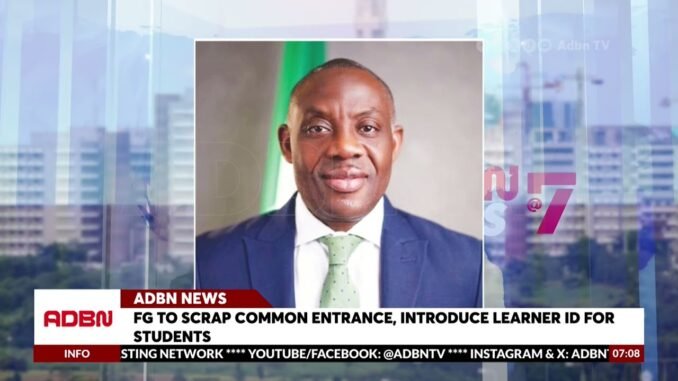

The Federal Government has unveiled a major shake-up of Nigeria’s education system that will affect millions of children across the country. In a move that could change how students are monitored from primary school to secondary school, the government plans to scrap the long-standing Junior Secondary School Common Entrance Examination and replace it with a nationwide tracking system.
What’s Changing?
The Minister of Education, Dr. Tunji Alausa, broke the news during a media briefing in Lagos, revealing that the common entrance exam many Nigerian parents and students have come to know will soon be history. Instead, a new Continuous Assessment (CA) system will take its place.
But that’s not all. Every student will now be assigned a Learner Identification Number (LIN) – a unique code that will follow them throughout their entire school life, no matter where they go or which school they attend.
Why Is the Government Doing This?
According to Minister Alausa, Nigeria has a serious problem: millions of children are disappearing from the education system between primary and secondary school.
The numbers tell a troubling story. While Nigeria has over 50,000 public primary schools with more than 23 million pupils, only about 3 million of these children make it into public junior secondary schools. That means over 20 million children are unaccounted for.
“Where are these children going?” the minister asked. “Private schools cannot absorb all of them. The truth is that many simply don’t have access to secondary education.”
How Will the New System Work?
Under the proposed reforms, every child entering primary school will receive a Learner Identification Number. This number will stay with the student throughout their academic journey, creating a permanent record that follows them from school to school, even across state lines.
The Continuous Assessment system will track each pupil’s academic performance starting from primary school. When a student changes schools, their records will automatically transfer with them, making it easier for teachers and administrators to understand each child’s learning history.
More importantly, the system will help government officials spot when students drop out. If a child who should be in JSS1 suddenly stops appearing in the system, authorities can quickly investigate and find out what happened.
School Feeding Programme Makes a Comeback
The government isn’t stopping at tracking students. Plans are also underway to revive and strengthen the school feeding programme, which many Nigerians remember as a key incentive for keeping children in school.
This time, however, the programme will be moved under the direct supervision of the Federal Ministry of Education to improve how it’s managed and monitored. The hope is that providing meals will encourage more parents to send their children to school and keep them there.
The Infrastructure Challenge
Minister Alausa didn’t mince words when discussing the scale of the problem. With so many children unable to access secondary education, he emphasized that state governments must urgently build more schools to meet the demand.
The proposed reforms are part of a larger strategy to strengthen Nigeria’s education system, reduce the number of children who drop out of school, and ensure that more young Nigerians complete their basic education.
What This Means for Parents and Students
For Nigerian families, these changes signal a new era in education management. Parents will no longer need to worry about their children’s records being lost when transferring schools. The LIN system means that every child’s academic history will be preserved and accessible.
Students, on the other hand, will no longer face the pressure of a single common entrance examination to determine their secondary school placement. Instead, their overall performance throughout primary school will be considered.
As these reforms roll out, the government hopes they will finally address the massive gap in Nigeria’s education system and ensure that millions more children can access and complete secondary education.
The question now is: will state governments rise to the challenge and build the schools needed to accommodate Nigeria’s growing population of young learners?
Stay tuned for more updates on buzzUp9ja
Be the first to comment