
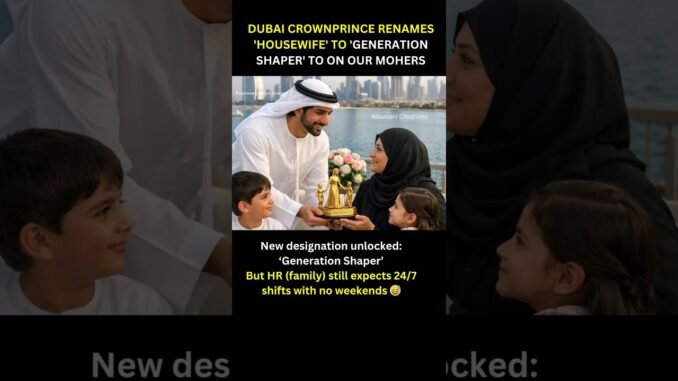

Summary: Sheikh Hamdan bin Mohammed, Dubai’s Crown Prince, has officially replaced the term “housewife” with “Generation Shaper” in recognition of mothers’ vital role in society. This bold move resonates across Africa and Nigeria.
In a move that has captured hearts across the world, including Nigeria where motherhood is deeply revered, Sheikh Hamdan bin Mohammed bin Rashid Al Maktoum, the Crown Prince of Dubai, has taken a bold step to honour women who dedicate their lives to raising families.
The Crown Prince has directed the Community Development Authority in Dubai to officially replace the term “Housewife” with “Generation Shaper” on all government documents and official platforms. This isn’t just a simple name change—it’s a powerful recognition of the invaluable work mothers do every single day.
Why “Generation Shaper” Matters
For too long, the term “housewife” has been used to describe women who stay home to raise their children, often with an undertone that diminishes the enormity of their contribution. But as any Nigerian mother—or father—will tell you, raising children is not just about cooking and cleaning. It’s about shaping values, instilling discipline, providing emotional support, and literally building the future generation.
Sheikh Hamdan’s decision acknowledges this truth in the most official way possible. By calling these women “Generation Shapers,” Dubai is telling the world that mothers are not just “staying home”—they are actively building society from the ground up.
A Message That Resonates in Nigeria
This news hits particularly close to home for Nigerians. In our culture, we have always understood the critical role mothers play. We have sayings like “The hand that rocks the cradle rules the world” and we recognize that behind every successful Nigerian—from Chimamanda Adichie to Wizkid—there’s usually a dedicated mother who sacrificed, prayed, and guided.
Nigerian mothers are known worldwide for their strength, resilience, and unwavering commitment to their children’s success. Whether it’s a mother waking up at 4 AM to prepare her children for school, or one juggling multiple side businesses while managing a household, or even the corporate executive who comes home to take on a “second shift” as mum—these women are indeed shaping generations.
Beyond Titles: Real Recognition
While some might dismiss this as merely symbolic, words matter. The language we use shapes how we think and how society values different roles. When official documents refer to stay-at-home mothers as “Generation Shapers” instead of “housewives,” it sends a clear message about their importance.
This change could inspire other nations, including Nigeria, to reconsider how we officially recognize and document the work of mothers. Imagine Nigerian government forms, school registration documents, and official records adopting similar language. It would be a powerful statement about our values as a nation.
What Nigerian Mothers Are Saying
The response from Nigerian women on social media has been overwhelmingly positive. Many have expressed that this recognition from Dubai validates what they’ve always known but rarely heard acknowledged in official capacities.
One Lagos-based mother commented online: “Finally, someone gets it! We’re not just ‘sitting at home.’ We’re raising future presidents, doctors, engineers, and good citizens. That’s nation-building.”
A Call for More Recognition
Sheikh Hamdan’s directive is more than a feel-good story—it’s a challenge to other leaders and societies to examine how they value the work of mothers and homemakers. In Nigeria, where family is the bedrock of society, perhaps it’s time for our own institutions to follow suit.
Whether you call them housewives, homemakers, stay-at-home moms, or now, Generation Shapers, one thing is clear: the women who dedicate themselves to raising the next generation deserve our deepest respect and official recognition.
As we celebrate this progressive move from Dubai, let’s also take a moment to appreciate the Generation Shapers in our own lives—our mothers, wives, sisters, and aunties who are quietly building Nigeria’s future, one child at a time.
What do you think? Should Nigeria adopt similar terminology? Share your thoughts in the comments below.
For more information, check buzzUp9ja
Be the first to comment