
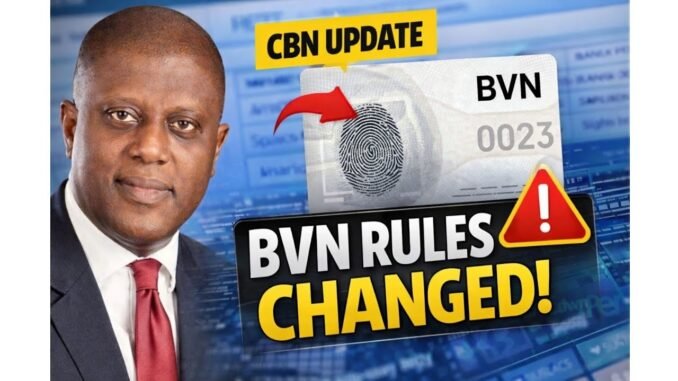

The Central Bank of Nigeria (CBN) has rolled out fresh regulations to strengthen the security of digital banking services across the country. These new measures, aimed at protecting customers and reducing fraud, will affect how Nigerians use mobile and internet banking from July 1, 2025.
The directive, contained in a circular dated March 12 and signed by Musa Jimoh, applies to all banks and payment service providers operating in Nigeria. According to the apex bank, the guidelines are part of efforts to safeguard Nigeria’s rapidly expanding digital payment ecosystem while giving customers more control over their transactions.
What’s Changing for Nigerian Bank Customers?
You Can Now Opt Out of Instant Payments
One of the most significant changes is that customers will now have the power to decide whether they want instant payment services enabled on their accounts. Banks must provide a simple option for users to opt in or opt out at any time.
“Customers shall have the option to opt-out of/opt-in to IP service at any time and for any given period,” the CBN stated. However, this process will require Multi-Factor Authentication (MFA) for security purposes. When you open a new account, instant payments will be automatically enabled unless you choose otherwise.
If you opt out, you won’t be able to make online transfers—whether to accounts within the same bank or to other banks. But you can still visit your bank’s branch physically to carry out transfers during this period.
Flexible Transaction Limits with Proper Verification
Under the new rules, customers can adjust their transaction limits, but within the existing regulatory caps: ₦25 million for individual accounts and ₦250 million for corporate accounts.
However, banks must conduct enhanced due diligence and proper risk assessment before approving any changes to your limits. Once approved through multi-factor authentication, the new limits take effect immediately.
Liveness Checks: Proving You’re Really You
Perhaps the most interesting addition is the introduction of liveness checks for online account opening and reactivation. This technology requires you to prove you’re physically present during identity verification by performing simple actions like blinking, smiling, speaking, or turning your head.
These checks will be conducted against the Bank Verification Number (BVN) and National Identification Number (NIN) databases, adding an extra layer of security against identity theft and fraud—a growing concern in Nigeria’s digital banking space.
One Device at a Time for Mobile Banking Apps
The CBN has also introduced a device binding requirement for mobile banking applications. This means your banking app can only be active on one device at a time. You won’t be able to use the same app simultaneously on multiple phones or tablets.
If you switch to a new device, the app will automatically require full re-authentication. This measure is designed to prevent unauthorized access if your phone is stolen or compromised.
₦20,000 Limit for First 24 Hours
For newly activated mobile banking apps—whether for new accounts or when you install the app on a new device—there will be a maximum transaction limit of ₦20,000 during the first 24 hours. This temporary restriction applies to both money coming in and going out of your account.
After the initial 24-hour period, normal transaction limits will apply.
Enhanced Fraud Monitoring Systems
Banks are now required to deploy enterprise-level fraud monitoring systems capable of tracking inflows and outflows in real-time to detect suspicious activities. This means financial institutions will be better equipped to spot and stop fraudulent transactions before they cause harm.
For internet banking users, logging in from a new device for the first time will trigger additional multi-factor authentication checks—another security layer to protect your account.
What This Means for You
These new regulations represent a significant shift in how digital banking operates in Nigeria. While some customers may find the additional verification steps slightly inconvenient, the measures are designed to protect your hard-earned money from increasingly sophisticated fraudsters.
The CBN emphasized that these rules represent the minimum standard for instant payment systems in Nigeria and are part of ongoing efforts to “enhance customer protection, strengthen fraud detection, and improve control over digital payment services.”
As Nigeria continues to lead Africa in fintech innovation and digital payment adoption, these measures should help build greater trust and confidence in our banking system. The key is finding the right balance between security and convenience—and these new guidelines attempt to do just that.
Note: All banks and payment service providers have until July 1, 2025, to implement these new requirements, so expect to see changes to your banking apps and online platforms in the coming months.
chech for more information on buzzUp9ja
Be the first to comment