
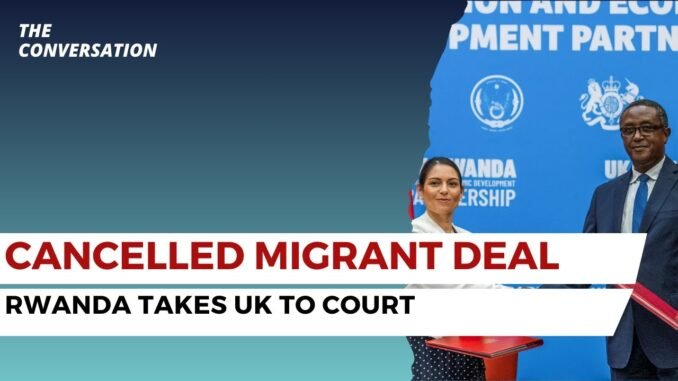

Summary: Rwanda takes Britain to international court, demanding over £100 million in unpaid funds from the collapsed migrant deportation scheme that sent only four people voluntarily.
The Permanent Court of Arbitration in The Hague became the battleground on Wednesday, March 18, as Rwanda squared up against Britain over money disputes stemming from a controversial immigration deal that ended in spectacular failure.
Rwanda is pursuing more than £100 million from the British government, claiming London has refused to settle outstanding payments after scrapping the widely criticized migrant deportation agreement.
Rwanda Says: “Show Us Our Money”
Speaking before the arbitration panel, Rwanda’s Justice Minister Emmanuel Ugirashebuja pulled no punches. He told the court that his country regretted having to drag Britain to court but had been left with no choice after what he called the UK’s “intransigence” – their stubborn refusal to pay what was agreed.
“We have been deprived of substantial funds that were agreed under this deal,” Ugirashebuja argued, making it clear that Kigali feels cheated.
The Deal That Went Nowhere
The whole wahala started in 2022 when former British Prime Minister Boris Johnson brokered an arrangement to send migrants who arrived in Britain through illegal routes straight to Rwanda. The idea was to discourage people from making dangerous journeys across the English Channel.
But from the jump, the plan faced serious legal challenges. Eventually, Britain’s highest court ruled the entire scheme unlawful – a massive blow to the government’s immigration strategy.
When Prime Minister Keir Starmer took over in July 2024, he didn’t waste time. He killed the policy completely, calling it “dead and buried.” His Home Secretary, Yvette Cooper, went further, slamming it as an expensive waste of taxpayers’ money.
The numbers tell the embarrassing story: only four people* were sent to Rwanda under the scheme, and all of them went voluntarily. Yet Britain had already paid approximately *£290 million to Rwanda before pulling the plug.
What Rwanda Is Claiming
Now, Kigali wants more money, breaking down their demands like this:
– £100 million in two outstanding annual payments of £50 million each
– £6 million additional compensation, claiming Britain breached a separate agreement to host vulnerable refugees, including those fleeing conflict in the Democratic Republic of Congo
– A formal apology from the British government
Rwanda insists that just because Britain cancelled the deal doesn’t mean they can walk away from financial commitments already made. In legal papers, Rwanda said it was “rightly aggrieved” by Britain’s decision to abandon its obligations based on changing political winds at home.
Britain Says: “Not So Fast”
The British government isn’t having any of it. London has dismissed Rwanda’s claims, arguing the case has “obvious weaknesses” and suggesting the lawsuit is politically motivated rather than genuinely about money.
Britain believes Rwanda’s real grievance is the UK’s decision to suspend most financial aid to Kigali over serious allegations that Rwanda is backing the M23 rebel group causing chaos in eastern Democratic Republic of Congo – a claim Rwanda has consistently denied.
The Bigger Picture: Diplomatic Tensions Rising
This court case is playing out against a backdrop of increasingly frosty relations between the two countries. What was supposed to be a partnership has turned into a full-blown dispute, with accusations flying in both directions.
Phil Clark, a professor of international politics at SOAS University of London, offered an interesting perspective. He suggested Rwanda’s timing was no accident – Kigali might be trying to remind international partners of its strategic importance, especially as criticism mounts over its alleged role in Congo’s instability.
What Happens Next?
Rwanda presented its arguments on Wednesday. Britain will get its turn to respond before both sides make final submissions later this week. However, don’t expect quick answers – the tribunal’s ruling could take several months.
For many Nigerians watching this drama unfold, there are lessons about international agreements and the importance of honouring commitments. The case also highlights how immigration policies can become political hot potatoes, with real financial and diplomatic consequences.
As one anonymous British official reportedly said: “You can’t just shake hands, collect money, and walk away when things get complicated.” Rwanda seems determined to prove exactly that point.
The question now is whether the arbitration panel will agree that Britain owes the money, or if Rwanda’s case will collapse like the deportation deal itself. Either way, this expensive lesson in immigration policy won’t be forgotten anytime soon.
The court is expected to deliberate for several months before delivering its verdict on this high-stakes international dispute.
For more details, check buzzUp9ja
Be the first to comment