
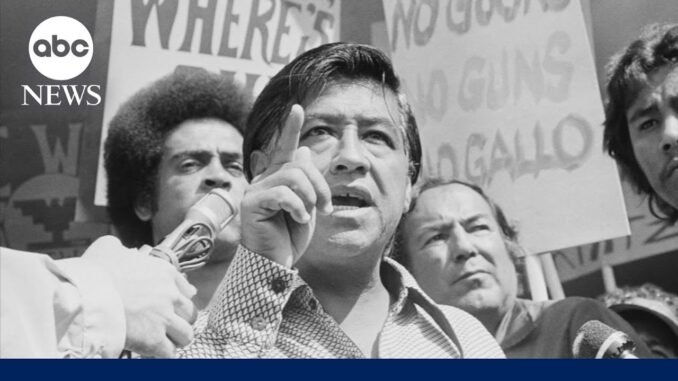

In a development that has sent shockwaves through the American civil rights community, Cesar Chavez, the legendary farm workers’ rights activist, has been accused of sexual abuse by multiple women, including his long-time collaborator and co-founder of the United Farm Workers union (UFW), Dolores Huerta.
The revelations, which come decades after Chavez’s death in 1993, have raised serious questions about separating an individual’s legacy from their personal conduct—a conversation Nigerians are all too familiar with, given our own national debates about honouring controversial historical figures.
The Allegations That Shook America
In a statement published online, 94-year-old Dolores Huerta, herself a civil rights icon, detailed how Chavez allegedly abused his position of power in the 1960s. According to Huerta, Chavez “manipulated and pressured” her into having sex on one occasion, and on another, forced himself on her against her will.
“The first time I was manipulated and pressured into having s£x with him, and I didn’t feel I could say no because he was someone that I admired, my boss and the leader of the movement I had already devoted years of my life to,” Huerta revealed in her statement.
“The second time I was forced, against my will, and in an environment where I felt trapped.”
More Victims Come Forward
Huerta’s testimony is not isolated. In a comprehensive investigation published by the New York Times on Wednesday, two additional women came forward with even more disturbing allegations. Both women claim they were minors—aged just 13 and 15—when Chavez first sexually molested them.
The newspaper’s investigation was thorough and extensive, relying on interviews with over 60 people, including former top aides, relatives, and former members of the United Farm Workers. Journalists also examined union records, confidential emails, photographs, and recordings of UFW board meetings to corroborate the claims.
Swift Backlash and Cancellations
The response has been immediate and decisive. Multiple events scheduled to celebrate Cesar Chavez Day—a commemorative holiday observed every 31st of March across the United States—have been either cancelled or renamed.
The United Farm Workers union itself announced it was cancelling its participation in the celebrations, though it noted in a statement that it had “not received any direct reports” and “do not have any firsthand knowledge” of the allegations prior to their publication.
California Governor Gavin Newsom has also weighed in, stating that the farm workers movement and labour movement “are much bigger than one man.” He expressed his support for “the courageous women” like Huerta and indicated openness to renaming Cesar Chavez Day in California.
Republican assemblywoman Alexandra Macedo has already taken legislative action, filing a bill to change the holiday’s name to “Farmworker Day.”
Leaders Speak Out
Los Angeles Mayor Karen Bass did not mince words in her condemnation. “The sickening reality is that what Dolores, Ana, and Debra endured is not isolated, nor is it of the past,” she said, demanding sustained action to dismantle structures that enable abuse of women.
The League of United Latin American Citizens (LULAC), a prominent civil rights organization, also issued a strong statement: “No individual, regardless of stature or legacy, is above accountability when it comes to protecting and upholding the dignity of others.”
Even the Cesar Chavez Foundation, established to continue the activist’s work, acknowledged being “deeply shocked and saddened” by the allegations. The foundation stated it is working with leaders in the Farmworker Movement to respond appropriately and support those who may have been harmed.
A Legacy Now in Question
For Nigerians watching this story unfold, there are parallels to our own ongoing conversations about accountability, power, and legacy. Just as we’ve grappled with how to remember complicated figures in our own history, Americans are now confronting the uncomfortable reality that one of their most celebrated civil rights leaders may have been a serial abuser.
Cesar Chavez, who was Mexican American, remains one of the most recognized Latinos in modern U.S. history. His work organizing farm workers—many of them immigrants labouring in difficult conditions for minimal pay—inspired generations of activists not just in America, but around the world.
His name adorns schools, streets, and public buildings across the United States. His image appears on murals, and his birthday is a state holiday in multiple states. For many Latino Americans, he represented hope, dignity, and the possibility of justice for the marginalized.
Now, that legacy faces its greatest test.
The Bigger Conversation
This case raises critical questions that resonate far beyond American borders:
Can we separate an individual’s public achievements from their private misconduct? Should we continue to honour people who made significant contributions to society but caused serious harm to others? And how do we balance the need to preserve important historical movements while holding their leaders accountable?
These are questions Nigerians have wrestled with regarding our own leaders and public figures. The #MeToo movement has shown us that power imbalances exist everywhere—in America, Nigeria, and across the globe—and that those in positions of authority sometimes exploit that power in the most harmful ways.
What Happens Next?
As this story continues to develop, it’s clear that America’s reckoning with Cesar Chavez’s alleged crimes is just beginning. Whether his name will remain on holidays, streets, and schools across the country remains to be seen.
What is certain, however, is that the brave testimonies of Dolores Huerta and the other survivors have opened an important conversation about accountability, justice, and the true meaning of civil rights—rights that must extend to all people, regardless of who is violating them.
For the farmworker movement that Chavez helped build, the challenge now is to ensure that the important work of advocating for vulnerable workers continues, even as they confront the painful truth about one of their founders.
As Nigerians, we understand that no movement, no matter how noble, is served by covering up abuse. True justice demands accountability for all—and that includes our heroes.
What do you think? Should historical figures accused of serious crimes still be honoured with public holidays and monuments? Share your thoughts in the comments below.
For more details, visit buzzUp9ja
Be the first to comment