
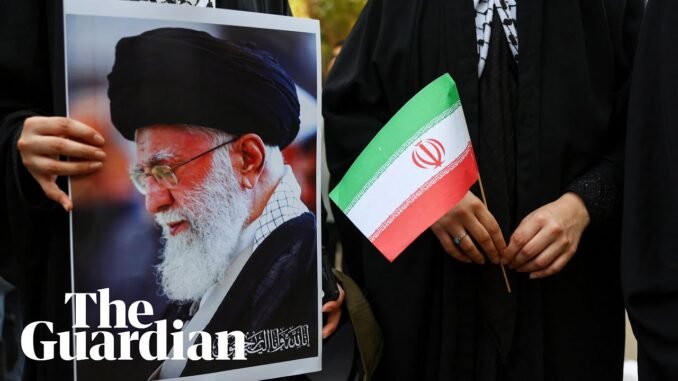

Summary: Iranian state media confirms the death of Supreme Leader Ayatollah Ali Khamenei in coordinated US-Israeli airstrikes on Tehran, triggering 40 days of national mourning and raising fears of escalating Middle East tensions.
—
In a shocking development that has sent ripples across the global stage, Iranian state television has confirmed that the country’s Supreme Leader, Ayatollah Ali Khamenei, has been killed in a series of devastating airstrikes carried out jointly by the United States and Israel.
The 85-year-old cleric, who had led the Islamic Republic since 1989, reportedly died alongside his daughter and several other top Iranian officials when missiles struck his heavily fortified compound in Tehran. His body was recovered from the rubble of what intelligence sources described as a high-security underground bunker.
Tears and Mourning Across Iran
A visibly emotional presenter on Iranian state television made the somber announcement, declaring that the nation would observe 40 days of official mourning—a period of profound significance in Islamic tradition. The news has plunged Iran into uncertainty, with many wondering what comes next for the Middle Eastern powerhouse.
Trump Declares “Justice” Served
US President Donald Trump wasted no time in confirming the operation on his Truth Social platform, describing Khamenei as “one of the most evil people in history.”
“This is not only justice for the people of Iran, but for all Great Americans,” Trump wrote, adding that the Iranian leader was unable to escape the reach of US intelligence and tracking systems.
In a stern warning, the American president promised that “heavy and pinpoint bombing will continue, uninterrupted throughout the week or as long as necessary,” signaling that this operation may only be the beginning of a larger campaign.
Trump also urged the Iranian people to seize what he called “the single greatest chance to take back their country.”
Operation Roaring Lion: A Calculated Strike
Israeli officials revealed that the airstrikes were part of a meticulously planned operation codenamed Operation Roaring Lion. According to the Israel Defense Forces (IDF), the mission had been in development for several months and was executed when intelligence confirmed that senior Iranian regime officials would be gathered in one location.
An Israeli military spokesperson explained: “Three sites where gatherings of the Iranian terror regime were taking place were struck simultaneously, and several senior figures essential to the regime’s governance were eliminated.”
The coordinated assault involved over 200 warplanes*, including advanced American F-22 Raptors and Tomahawk cruise missiles, targeting more than *500 locations across Tehran and other strategic sites. US aircraft carriers positioned across the region provided crucial support.
Among those reportedly killed were Iran’s defence minister and multiple senior commanders of the Revolutionary Guard. While Iran initially dismissed reports of Khamenei’s death as “mental warfare,” the supreme leader’s failure to appear for a scheduled televised address fueled growing speculation—speculation that has now been tragically confirmed.
Iran Strikes Back
Iran did not take the assault lying down. In swift retaliation, the Islamic Republic launched missile and drone strikes targeting American military bases in Bahrain, Kuwait, Qatar, and the United Arab Emirates.
Explosions rocked the Fifth Fleet headquarters in Bahrain and the crucial Al-Udeid airbase in Qatar. One person was confirmed dead in Abu Dhabi, while Israeli emergency services reported 89 people suffering minor injuries following interceptions over Jerusalem and Tel Aviv.
Perhaps most alarming for Nigerians and other nationals in the Gulf region, footage circulating online showed flames rising near the luxurious Palm Jumeirah Fairmont hotel in Dubai after what appeared to be a drone strike. Thousands of British tourists and expatriates—as well as many Nigerians working and living in the UAE—scrambled for safety.
What This Means for the Middle East
The death of Ayatollah Khamenei marks a seismic shift in Middle Eastern geopolitics. The Islamic Republic, established following the 1979 revolution, now faces an uncertain future. Questions about succession, stability, and the potential for further escalation loom large.
Israeli Prime Minister Benjamin Netanyahu has openly called on ordinary Iranians to “take to the streets en masse” and overthrow what remains of the regime—a direct appeal that underscores the volatile nature of this moment.
For now, military operations across the region continue, and Iranian authorities have yet to outline any formal transition plan.
The Nigerian Angle
For Nigerians, particularly the thousands living and working in Gulf states like the UAE, Qatar, and Kuwait, the escalation raises serious safety concerns. The Nigerian government and its embassies in the region have yet to issue formal travel advisories, but many are already taking precautionary measures.
Oil markets are also expected to react sharply to the news, which could have ripple effects on fuel prices back home in Nigeria—a country heavily dependent on petroleum imports despite being an oil-producing nation.
As this story continues to unfold, Nigerians both at home and abroad are watching closely, aware that instability in the Middle East rarely remains contained.
—
Watch the video of the Iranian state TV announcement below:
[Video embedded from Instagram – Lindaikejiblog]
Check buzzUp9ja for more information
Be the first to comment