
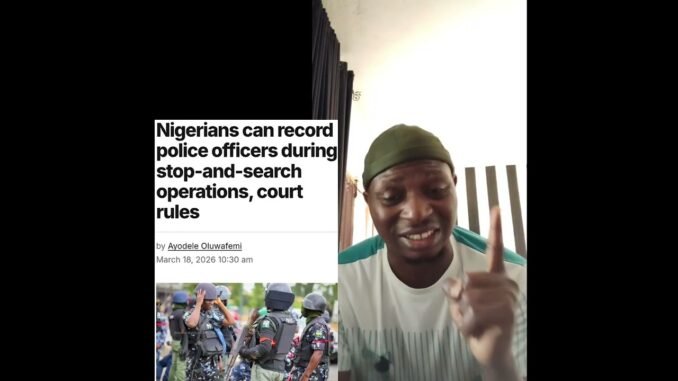

Summary: A Federal High Court in Warri has ruled that Nigerian citizens have the constitutional right to record police officers during stop-and-search operations. Police must also wear visible name tags and force numbers.
In a landmark judgment that has sent waves across the nation, a Federal High Court sitting in Warri, Delta State, has affirmed the constitutional right of Nigerians to record police officers during stop-and-search operations and other public engagements.
Justice Hyeladzira Nganjiwa delivered the historic ruling on Tuesday, March 17, following a fundamental rights enforcement suit filed by Maxwell Nosakhare Uwaifo, a Nigerian lawyer who had experienced firsthand the intimidation many citizens face at police checkpoints.
The Story Behind the Lawsuit
Uwaifo’s ordeal, which became the catalyst for this groundbreaking legal action, occurred on May 10, 2025, along the Sapele roundabout while travelling from Benin to Warri. According to the lawyer, plain-clothed police officers flagged down his vehicle and immediately began questioning him aggressively.
When he attempted to record the encounter with his phone—a natural response many of us would have in such situations—the officers threatened him with arrest and ordered him to put his device away.
“They did not wear any name tags, nor did they introduce themselves,” Uwaifo recounted to the court. “The vehicle they used was a Toyota Sienna, painted black, with no police inscription, no plate number, and no markings whatsoever to identify it as a police vehicle.”
The lawyer described the atmosphere as hostile and intimidating, leaving him with no choice but to comply out of fear of physical assault, unlawful detention, or having his phone forcefully seized.
“I have heard and seen many similar instances where police officers intimidate, harass, and even assault Nigerians simply for recording them or questioning their unlawful acts at checkpoints,” he added.
What the Court Decided
Justice Nganjiwa’s ruling addressed several critical issues that affect millions of Nigerians who navigate checkpoints daily:
1. Right to Record Police Officers
The court declared that Nigerians have the constitutional right under Section 39 of the 1999 Constitution to freely express themselves, including recording law enforcement agents performing public duties in public spaces.
2. Police Must Wear Identification
The judge ruled that police officers must wear visible name tags and display force numbers or proper identification during public operations. Conducting stop-and-search operations without these identifications is now deemed unconstitutional and illegal.
3. No Harassment for Recording
The court held that it is unlawful for police officers to harass, intimidate, arrest, or seize devices from citizens simply for recording their activities in public spaces.
4. Damages Awarded
The court awarded N5 million in damages for violation of fundamental rights and an additional N2 million for litigation costs.
Why This Ruling Matters
For the average Nigerian, this judgment is more than just legal jargon—it’s a shield against the abuse of power that has become all too common at police checkpoints across the country.
How many times have we heard stories of innocent citizens being harassed, extorted, or worse, simply because they dared to question or record police conduct? How many young people have had their phones seized or smashed for trying to document their encounters with law enforcement?
This ruling sends a clear message: Nigerian citizens have rights, and those rights cannot be trampled upon, even by those sworn to protect them.
What This Means for You
If you’re stopped by police officers at a checkpoint or during any public operation, you now have legal backing to:
– Record the encounter with your phone or any recording device
– Demand that officers identify themselves through visible name tags and force numbers
– Refuse intimidation, threats, or unlawful seizure of your recording device
The court has also mandated disciplinary action against any officer who violates these rights.
The Respondents
The suit named several key defendants:
– The Inspector-General of Police
– The Nigeria Police Force (NPF)
– The Police Service Commission (PSC)
– The Attorney-General of the Federation (AGF)
While the police were not represented in court during the proceedings, the AGF was represented by Babatunde Ajajogun and D.O. Tarfa.
A Victory for Accountability
This judgment represents a significant step toward police accountability and transparency in Nigeria. It reinforces the principle that law enforcement officers are public servants who must conduct themselves according to the law, not above it.
As Nigerians, we must now familiarize ourselves with these rights and exercise them responsibly. At the same time, we must continue to push for systemic reforms that will ensure these rights are respected nationwide.
The days of “don’t record me” at checkpoints may finally be numbered. This is your country, and these are your rights. Know them. Use them. Protect them.
Have you experienced similar encounters with police officers at checkpoints? How do you think this ruling will change police-citizen interactions in Nigeria? Share your thoughts in the comments below.
Visit buzzUp9ja for more updates
Be the first to comment