
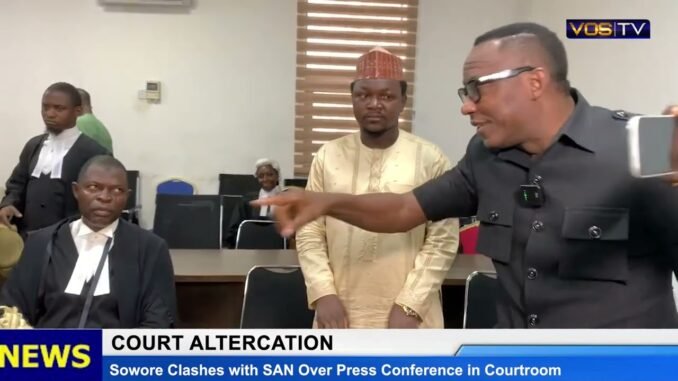

Summary: NBA President Afam Osigwe criticizes activist Omoyele Sowore for holding a press briefing inside a courtroom, calling it an affront to the rule of law and warning against using courts as media stages.
The President of the Nigerian Bar Association (NBA), Afam Osigwe (SAN), has issued a stern warning against the practice of holding media briefings inside courtrooms, describing such actions as a disrespect to the sanctity of Nigeria’s judicial system.
Osigwe’s statement comes in direct response to activist and publisher Omoyele Sowore’s decision to conduct a press briefing within a courtroom—a move that has sparked heated debate within Nigeria’s legal community about courtroom decorum and the boundaries of press freedom.
NBA Chief Speaks Out on Courtroom Conduct
In a strongly-worded reaction, the NBA president made it clear that while freedom of expression remains a fundamental right guaranteed under Nigeria’s Constitution, the courtroom is not the appropriate venue for media engagements.
“The courtroom is a temple of justice, not a press centre,” Osigwe emphasized, warning that such practices undermine the dignity and solemnity that Nigerian courts represent.
The senior advocate stressed that courts across the country must maintain their integrity as spaces dedicated solely to the administration of justice, free from distractions that could compromise proceedings or disrespect judicial authority.
The Sowore Incident: What Happened?
Omoyele Sowore, founder of Sahara Reporters and a well-known activist who ran for president in 2019, reportedly held a media briefing inside a courtroom, addressing journalists and cameras in a manner typically reserved for press conference venues.
This is not Sowore’s first brush with controversy in Nigerian courts. The activist has been involved in several high-profile cases over the years, including his arrest and prosecution for calling for a #RevolutionNow protest in 2019.
However, this latest incident has drawn criticism not for the content of his statements but for the location where he chose to make them.
Legal Experts Weigh In
The NBA president’s position reflects broader concerns within Nigeria’s legal community about maintaining respect for judicial processes.
Legal experts have pointed out that courtrooms operate under strict protocols designed to ensure fairness, order, and the proper administration of justice. These protocols include rules about when and how parties can address the media regarding ongoing cases.
“There are designated areas outside courtrooms where lawyers and parties can engage with the press,” one Lagos-based lawyer explained. “Turning the courtroom itself into a media circus sets a dangerous precedent.”
Balancing Press Freedom and Judicial Dignity
Nigeria’s democracy thrives on the delicate balance between various fundamental rights, including freedom of expression and the right to fair hearing. The question many are now asking is: where should the line be drawn?
While activists and civil society organizations argue that transparency in judicial processes is essential for accountability, legal practitioners maintain that such transparency should not come at the expense of courtroom decorum.
The NBA president’s statement appears aimed at establishing clear boundaries: engage with the press, yes—but respect the sanctity of the courtroom while doing so.
Implications for Future Court Proceedings
Osigwe’s warning sends a clear message to all parties involved in litigation across Nigeria: courtrooms have rules, and those rules apply to everyone, regardless of social status or public profile.
The incident raises important questions about enforcement. Will courts begin to impose stricter controls on media access? Could parties who violate courtroom protocols face contempt charges?
These are questions that Nigerian judicial authorities may need to address as the conversation around this incident continues.
The Bigger Picture: Respect for Institutions
At its core, this controversy touches on a fundamental issue in Nigeria’s democratic development: respect for institutions.
Whether it’s the judiciary, the legislature, or the executive, Nigeria’s progress depends on citizens—especially public figures—demonstrating respect for institutional processes and protocols.
As the NBA president rightly pointed out, allowing courtrooms to become venues for media spectacles represents an “affront to the rule of law”—a development that could gradually erode public confidence in the judicial system.
What Happens Next?
As of now, it remains unclear whether any formal sanctions will be imposed regarding the courtroom press briefing. However, the NBA president’s public condemnation serves as a warning that such behavior will not be tolerated going forward.
For Sowore and other activists who frequently find themselves in Nigerian courts, the message is clear: advocate, protest, and engage the media—but do so in the appropriate venues and with proper respect for judicial processes.
The Nigerian Bar Association, as the umbrella body for legal practitioners in the country, has a responsibility to protect the integrity of the legal profession and the judicial system. Osigwe’s statement demonstrates that the association is prepared to speak out when it perceives threats to that integrity, regardless of who is involved.
Check buzzUp9ja for more details
Be the first to comment