
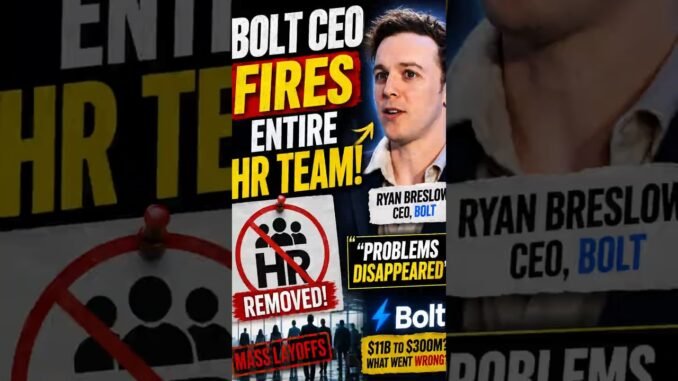

Summary: Bolt CEO Ryan Breslow justifies controversial decision to fire entire HR department, sparking debate about workplace management in tech companies.
—
In a move that has sent shockwaves through the global tech community, Ryan Breslow, co-founder and CEO of American fintech company Bolt, has come out to defend his controversial decision to sack the company’s entire Human Resources team.
According to Breslow, the drastic action was necessary because the HR department had been “creating problems that didn’t exist” within the organization.
The Controversial Decision
The mass firing, which affected every member of Bolt’s HR team, has sparked heated debate about management practices in the technology sector. For many Nigerians familiar with the corporate world, where HR departments typically serve as mediators between management and staff, such a sweeping decision raises serious questions.
Breslow’s justification for the decision suggests deep frustration with what he perceived as unnecessary bureaucracy and artificial obstacles being placed in the company’s path to success.
“Problems That Didn’t Exist”
The CEO’s statement implies that rather than solving workplace issues, the HR team was allegedly manufacturing conflicts and complications. While Breslow hasn’t provided specific examples of these so-called “invented problems,” his bold stance has divided opinion among business leaders and employees alike.
In the Nigerian context, where relationships and interpersonal dynamics are highly valued in the workplace, the idea of eliminating an entire HR department seems particularly radical. HR professionals here often play crucial roles in managing the diverse personalities and cultural sensitivities that exist in our multi-ethnic work environments.
What This Means for Modern Workplaces
The incident at Bolt raises important questions about the role of HR in contemporary companies:
– Are HR departments becoming too bureaucratic? Some argue that excessive processes and policies can stifle innovation and productivity.
– Can companies function without dedicated HR? This remains to be seen, but the traditional functions of recruitment, conflict resolution, and employee welfare still need addressing.
– Is this the future of lean startups? Tech companies increasingly favour flat structures, but completely eliminating HR represents an extreme approach.
The Nigerian Perspective
For Nigerian businesses and startups looking to the West for inspiration, this development offers a cautionary tale. While streamlining operations makes sense, the complete removal of HR infrastructure may not translate well to our local context where:
– Labour laws require proper documentation and compliance
– Workplace disputes benefit from neutral mediation
– Employee welfare and engagement need dedicated attention
– Cultural sensitivity requires specialized understanding
Industry Reactions
The tech industry has responded with mixed reactions. Some founders and executives have praised Breslow’s boldness, seeing it as a necessary disruption of outdated corporate structures. Others view it as reckless management that could expose the company to legal risks and damage employee morale.
The Bottom Line
While Ryan Breslow’s decision to fire Bolt’s entire HR team demonstrates his willingness to take unconventional approaches to management, only time will tell whether this bold move pays off or backfires.
For Nigerian entrepreneurs and business leaders, the key takeaway isn’t necessarily to eliminate HR departments wholesale, but rather to ensure that every function within an organization adds genuine value and solves real problems rather than creating artificial ones.
As our own tech ecosystem continues to grow and mature, we must find the right balance between necessary structure and entrepreneurial agility – a balance that works for our unique Nigerian business environment.
What do you think? Can companies truly function without HR departments, or is this a recipe for disaster? Share your thoughts in the comments below.
Follow for more news on buzzUp9ja
Be the first to comment