
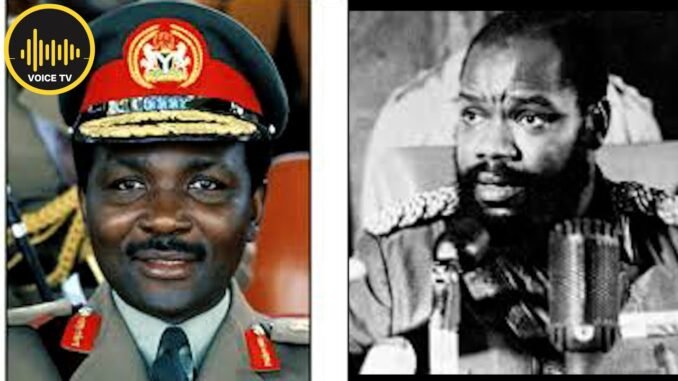

Summary: Former Head of State Yakubu Gowon speaks on the Nigerian Civil War, claiming Ojukwu sabotaged peace efforts including the Aburi Accord that could have prevented Biafra’s secession.
Over five decades after the Nigerian Civil War ended, former Head of State General Yakubu Gowon has reignited one of the most contentious debates in Nigeria’s history. The 88-year-old military leader has alleged that the late Biafran leader, Chukwuemeka Odumegwu Ojukwu, deliberately frustrated multiple peace initiatives that could have prevented the devastating 30-month conflict.
The civil war, which lasted from 1967 to 1970, remains a deeply emotional chapter in Nigeria’s journey as a nation. It claimed an estimated one to three million lives, mostly from the Eastern region, and left scars that continue to shape Nigerian politics and inter-ethnic relations today.
The Aburi Accord: A Missed Opportunity for Peace?
At the heart of Gowon’s recent revelations is the famous Aburi Accord of January 1967. This agreement, reached during a meeting of Nigerian military leaders in Aburi, Ghana, was widely seen as the last real chance to keep Nigeria united and avoid bloodshed.
According to Gowon, the accord represented a genuine effort by all parties to address the concerns of the Eastern region following the tragic pogroms of 1966, which saw thousands of Igbos killed in Northern Nigeria. However, he insists that upon returning to Nigeria, Ojukwu began reinterpreting the agreement in ways that were never discussed or agreed upon in Ghana.
“We went to Aburi in good faith,” Gowon reportedly stated. “But Ojukwu came back with a completely different interpretation of what we agreed on. He wanted a loose confederation that would have made Nigeria ungovernable.”
What Really Happened at Aburi?
The Aburi meeting brought together Nigeria’s military governors and leaders, including Gowon and Ojukwu, in a neutral location to hammer out a solution to Nigeria’s escalating crisis. The discussions centered on how to restructure Nigeria’s governance to address regional concerns while maintaining national unity.
Both sides have historically claimed that the other violated the Aburi agreements. Ojukwu’s supporters have long maintained that it was the federal government in Lagos that failed to implement what was agreed upon, particularly regarding the decentralization of power and the autonomy of regions.
Gowon, however, paints a different picture. He suggests that Ojukwu’s demands after Aburi went far beyond what was discussed, effectively pushing for Biafra’s independence under the guise of implementing the accord.
The Path to War
When the Aburi Accord collapsed amid mutual accusations of bad faith, events moved rapidly toward conflict. On May 30, 1967, Ojukwu declared the Eastern region’s secession from Nigeria, establishing the Republic of Biafra. Gowon’s government responded by dividing Nigeria into 12 states, a move that further complicated the situation, and eventually launched military operations to bring the Eastern region back into the federation.
The war that followed remains one of Africa’s deadliest conflicts. Images of starving Biafran children became symbols of humanitarian crisis, drawing international attention and sympathy. The blockade of Biafra led to widespread famine, and the suffering of civilians became one of the war’s most tragic legacies.
Why This Matters Today
Gowon’s decision to speak out now, decades after the war, comes at a time when calls for Biafra’s independence have resurfaced through groups like the Indigenous People of Biafra (IPOB). These modern-day agitators cite historical grievances, marginalization, and unfulfilled promises as reasons why the Southeast should break away from Nigeria.
Many Nigerians, particularly younger generations who did not experience the civil war, have varying perspectives on this history. Some in the Southeast view Ojukwu as a hero who stood up for his people’s survival. Others across Nigeria see the secession attempt as a tragic mistake that brought unnecessary suffering.
Gowon’s account seeks to shift responsibility for the war’s outbreak squarely onto Ojukwu’s shoulders. However, historians and analysts have long noted that the causes of the civil war were complex, involving ethnic tensions, political rivalries, economic interests (particularly oil in the Niger Delta), and the failure of Nigeria’s post-independence political class to build inclusive institutions.
The Reconciliation Question
Since the war ended in January 1970, Gowon has consistently promoted his “No Victor, No Vanquished” policy, which aimed to reintegrate Biafrans into Nigeria without retribution. While this policy had noble intentions, many Igbos argue that they faced systematic marginalization in the decades that followed, including the controversial abandonment of the 20-pound policy that limited bank withdrawals for former Biafrans regardless of their pre-war savings.
Today’s Nigeria still grapples with the legacy of that conflict. Issues of restructuring, true federalism, resource control, and equitable representation remain hotly debated. The Southeast continues to voice concerns about being sidelined in federal appointments and infrastructure development.
What Nigerians Are Saying
Reactions to Gowon’s comments have been predictably divided along regional and generational lines. Some Northern and Western Nigerians support his account, viewing it as setting the historical record straight. Many in the Southeast, however, see it as an attempt to rewrite history and absolve the federal government of responsibility for the war’s devastation.
Social media has been ablaze with debates, with hashtags related to Biafra and the civil war trending. Young Nigerians are engaging with this history in new ways, demanding fuller accounts of what happened and why.
Moving Forward
Whether one agrees with Gowon’s version of events or not, his revelations underscore the importance of honest dialogue about Nigeria’s past. The civil war’s wounds have never fully healed, and until Nigerians can have frank, inclusive conversations about what went wrong and how to build a more equitable federation, the ghosts of 1967-1970 will continue to haunt the nation.
As Nigeria navigates contemporary challenges—from insecurity to economic hardship to renewed agitations for self-determination—the lessons of the Aburi Accord and the civil war remain painfully relevant. Peace, it seems, requires not just agreements on paper, but genuine commitment to justice, equity, and mutual respect among Nigeria’s diverse peoples.
The question facing Nigeria today is whether current leaders can learn from the failures of Aburi and chart a different course—one that addresses legitimate grievances before they explode into crisis.
What do you think? Did Ojukwu frustrate peace efforts, or was the federal government unwilling to grant the autonomy the East needed? Share your thoughts in the comments below.
Visit buzzUp9ja for more details
Be the first to comment