
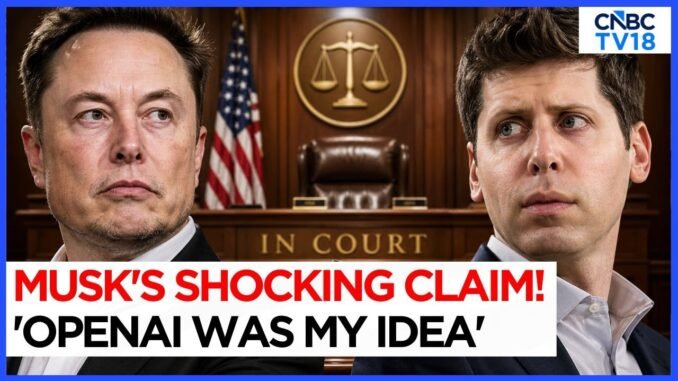

Summary: Elon Musk testifies that OpenAI, the company behind ChatGPT, was originally his idea before executives “looted” it. Find out what the billionaire told the court about OpenAI’s alleged betrayal.
The Tesla billionaire has dragged ChatGPT’s parent company to court, accusing top executives of betraying the company’s original mission and stealing his vision.
The battle between Elon Musk and OpenAI, the artificial intelligence company behind the popular ChatGPT chatbot, has entered a dramatic new phase. The Tesla and SpaceX CEO recently took the witness stand in a closely-watched court case, making explosive claims about how the company he helped birth has allegedly strayed far from its founding principles.
“They Looted My Vision” – Musk’s Bold Claims
Standing before the court, Musk didn’t mince words. The tech billionaire accused OpenAI’s current leadership of abandoning the company’s original mission and betraying both him and the general public. According to Musk, OpenAI was fundamentally his idea—a vision that has since been “looted” by executives who now run the organization.
For those following Nigeria’s tech scene and the global AI revolution that’s transforming everything from customer service to content creation, this case carries significant implications. OpenAI’s ChatGPT has become a household name worldwide, including among Nigerian entrepreneurs, students, and professionals who use it daily for research, business, and creative work.
The Origins: A Non-Profit Dream
When OpenAI was founded in 2015, Musk was among its most prominent backers. The company was established as a non-profit research organization with a clear mission: to ensure that artificial intelligence benefits all of humanity, not just wealthy corporations or powerful nations.
Musk’s involvement wasn’t just financial—he reportedly played a key role in shaping the company’s philosophy and direction. The vision was simple but ambitious: create AI technology that would be open, transparent, and accessible to everyone.
What Changed? The Microsoft Deal
The relationship between Musk and OpenAI began souring around 2018 when the billionaire stepped down from the company’s board. However, the real controversy erupted after OpenAI transformed from a non-profit into a “capped-profit” company and subsequently partnered with Microsoft in a multi-billion dollar deal.
This partnership gave Microsoft exclusive access to OpenAI’s technology, including the powerful GPT models that power ChatGPT. For Musk, this represented everything OpenAI was supposed to stand against—the privatization and monopolization of advanced AI technology.
Why Nigerians Should Care
You might wonder: why should this Silicon Valley drama matter to us here in Nigeria? The answer is simple—artificial intelligence is no longer a distant future technology. It’s here, and it’s reshaping our world right now.
Nigerian developers, content creators, businesses, and students increasingly rely on AI tools like ChatGPT. The question of who controls these technologies, how they’re developed, and whether they serve public or private interests affects everyone who uses them.
If Musk’s allegations are true, it means one of the world’s most influential AI companies may have betrayed its founding promise to serve humanity broadly, opting instead for profit and corporate partnerships.
The Court Battle Ahead
Legal experts predict this case could set important precedents for how AI companies are governed and held accountable. Musk isn’t just seeking damages—he wants the court to examine whether OpenAI violated its original charter and misled its early supporters about its intentions.
The outcome could influence how future AI companies structure themselves and whether the technology remains accessible or becomes increasingly controlled by a handful of powerful corporations.
What OpenAI Says
For its part, OpenAI has defended its transformation, arguing that the capped-profit structure was necessary to attract the massive investment required to develop cutting-edge AI safely and responsibly. The company maintains it remains committed to its mission of ensuring AI benefits humanity.
OpenAI’s leadership has also suggested that Musk’s complaints stem partly from his decision to leave the company and his competitive interests in developing his own AI ventures through companies like xAI and Tesla.
The Bigger Picture
This legal drama highlights a fundamental tension in the tech world: can companies truly serve the public good while pursuing profit? Can artificial intelligence remain democratized, or will it inevitably concentrate in the hands of tech giants and their wealthy backers?
For Nigerians and Africans more broadly, these questions matter deeply. Our continent cannot afford to be mere consumers of AI technology developed and controlled entirely by Western corporations. We need African voices, perspectives, and interests represented in how these world-changing technologies evolve.
What Happens Next?
The trial continues, with more witnesses expected to testify about OpenAI’s transformation and whether it violated its commitments. Legal observers say the case could drag on for months, given its complexity and the high stakes involved.
Whatever the outcome, one thing is clear: the battle over OpenAI is really a battle over the future of artificial intelligence itself—who controls it, who benefits from it, and whether it will truly serve all of humanity or just those who can afford access.
As we watch this drama unfold from Lagos to Abuja, Nigerians would do well to pay attention. The decisions made in courtrooms and boardrooms today will shape the AI-powered world we’ll all inhabit tomorrow.
What do you think? Should AI technology remain open and accessible, or is commercialization inevitable? Share your thoughts in the comments below.
For more updates, visit buzzUp9ja
Be the first to comment