
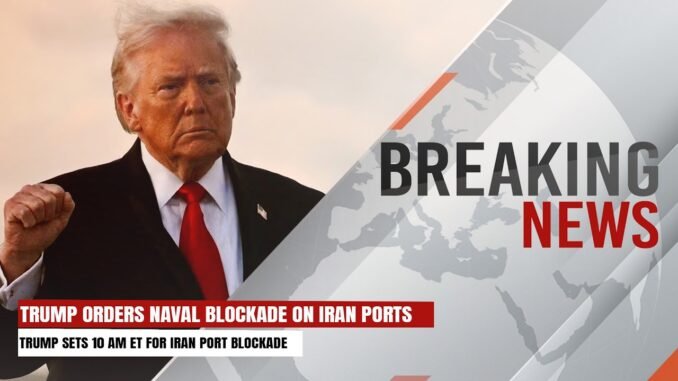

The United States under President Donald Trump is preparing for a dramatic escalation in its confrontation with Iran. According to breaking reports, Trump has directed his national security team to organize a comprehensive, long-term blockade of Iran’s maritime ports—a move designed to pressure Tehran into completely abandoning its nuclear weapons program.
What’s Happening?
The American president has reportedly given explicit instructions to his security advisors to draw up detailed plans for what would be one of the most significant military-enforced blockades in recent history. The strategy aims to strangle Iran’s economy by preventing goods from entering or leaving the country through its critical port facilities along the Persian Gulf and the Gulf of Oman.
This blockade would represent a massive escalation beyond the economic sanctions that have been the primary tool of American pressure on Iran for years. While sanctions target specific transactions and entities, a full naval blockade would physically prevent ships from accessing Iranian waters—an act that international law traditionally considers close to an act of war.
Why Does This Matter to Nigeria?
For Nigerians, particularly those watching fuel prices at the pump, this development carries serious implications. Iran sits on some of the world’s largest oil and gas reserves and controls the strategic Strait of Hormuz, through which nearly one-fifth of global oil supplies pass daily.
Any military confrontation or blockade in this region typically sends shockwaves through international oil markets. When oil prices spike globally, Nigeria—despite being an oil producer—often experiences increased fuel costs due to our heavy dependence on imported refined petroleum products.
Nigerian businesses already struggling with high operating costs due to fuel expenses could face additional pressure if this standoff escalates. Transportation costs, which affect everything from food prices to manufacturing, would likely increase.
The Nuclear Question
At the heart of this confrontation lies Iran’s nuclear program. Western powers, led by the United States, have long suspected that Tehran’s nuclear activities extend beyond civilian energy production to developing nuclear weapons capability—something Iran consistently denies.
Trump’s previous administration withdrew from the multinational Iran nuclear deal (formally known as the Joint Comprehensive Plan of Action) in 2018, arguing it was insufficient to prevent Iran from eventually obtaining nuclear weapons. Since then, tensions have fluctuated between diplomatic engagement and military brinkmanship.
What Makes a Blockade So Serious?
Unlike sanctions, which are economic measures, a naval blockade involves military forces physically preventing vessels from entering or leaving a country’s ports. This is considered an act of war under international law, which is why such measures are rarely implemented except during active armed conflicts.
If the United States proceeds with this plan, it would need to deploy significant naval assets to the region—aircraft carriers, destroyers, submarines, and support vessels—to enforce the blockade. This would require coordination with regional allies and would almost certainly provoke a strong response from Iran and its supporters.
Regional and Global Implications
The Middle East remains a powder keg where miscalculations can quickly spiral into wider conflict. Iran has powerful proxy forces throughout the region, including in Lebanon, Syria, Iraq, and Yemen. A blockade could trigger responses that extend far beyond Iran’s borders.
Russia and China, both of which maintain significant economic and political relationships with Iran, would likely oppose such a move. This could strain already tense relationships between these major powers and the United States.
For the global economy still recovering from recent disruptions, a major confrontation in the Gulf would create enormous uncertainty. International shipping companies would need to reroute vessels, insurance costs would skyrocket, and supply chains could face renewed disruptions.
Nigeria’s Position
As a member of the Organization of Islamic Cooperation (OIC) and a country that maintains diplomatic relations with both the United States and Iran, Nigeria would face delicate diplomatic challenges. Our government would need to balance relationships with Washington while avoiding unnecessarily antagonizing Tehran.
Nigerian students, businesspeople, and diplomats in the region could also be affected if the situation deteriorates into open conflict.
What Happens Next?
At this stage, these reports indicate planning and preparation rather than immediate action. Military planning for various scenarios is routine for major powers, and not all plans are ultimately executed.
However, the fact that Trump has reportedly given specific instructions to prepare for such a blockade signals that this option is being seriously considered at the highest levels of American government. The coming weeks will reveal whether this is a genuine policy direction or a pressure tactic designed to bring Iran to the negotiating table.
Diplomatic efforts, regional responses, and statements from international organizations like the United Nations will provide important signals about how seriously the world is taking these reports.
The Bottom Line
For Nigerians, this situation deserves close attention. While geographically distant, events in the Persian Gulf have historically had immediate impacts on our economy, particularly through energy prices and global economic stability.
As this situation develops, staying informed about Middle Eastern developments isn’t just about international affairs—it’s about understanding factors that directly affect the price of fuel, the cost of goods, and the stability of the global economy on which Nigeria depends.
The next chapter in U.S.-Iran relations could be written in the waters of the Persian Gulf, and its effects will be felt far beyond the Middle East, including right here in Nigeria.
Stay connected for updates on this developing story and its implications for Nigeria and West Africa.
Check buzzUp9ja for more information
Be the first to comment