
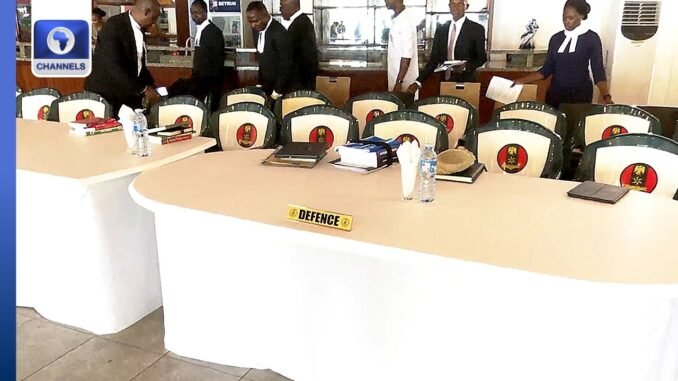

The Defence Headquarters (DHQ) has commenced court-martial proceedings against 36 military officers accused of plotting to overthrow President Bola Ahmed Tinubu’s administration. The trial, which began on Thursday, April 24, marks one of the most significant security cases since the current administration took office in May 2023.
The Charges
The 36 defendants, comprising officers from various ranks and divisions of the Nigerian Armed Forces, face serious charges related to alleged conspiracy to commit treasonable felony and intent to destabilize the federal government. Sources familiar with the matter indicate that the accused officers were arrested at different times and locations across the country following intelligence reports.
Background of the Case
This development comes amid heightened security concerns in Nigeria, as the Tinubu administration grapples with multiple challenges including insurgency in the Northeast, banditry in the Northwest, separatist agitations in the Southeast, and general economic hardship affecting millions of Nigerians.
Military sources, speaking on condition of anonymity, revealed that the investigation into the alleged coup plot had been ongoing for several months before the officers were formally charged and arraigned before the military tribunal.
Historical Context
Nigeria has a history of military interventions in politics, with successful coups in 1966, 1975, 1983, and 1993, among others. However, since the country returned to democratic rule in 1999, the military has largely remained professional and subordinate to civilian authority. The last significant coup plot was allegedly uncovered in 2004 during the Obasanjo administration.
What This Means
The trial underscores the Tinubu administration’s zero-tolerance stance on any attempts to undermine Nigeria’s democratic institutions. It also highlights the ongoing security intelligence work being conducted to protect the country’s constitutional order.
Legal experts note that court-martial proceedings differ significantly from civilian trials, with military law and regulations governing the process. If found guilty, the accused officers could face severe penalties including dismissal from service, lengthy imprisonment, or even death sentences, depending on the specific charges and evidence presented.
Public Reaction
The trial has generated mixed reactions among Nigerians on social media and in public discourse. While many citizens support the protection of democratic governance, others are calling for transparency in the trial process and fair hearing for all accused persons.
Human rights organizations have also expressed interest in monitoring the proceedings to ensure due process is followed and the rights of the defendants are protected throughout the trial.
Moving Forward
As the trial progresses, many Nigerians will be watching closely to see how the military justice system handles this sensitive case. The outcome could have significant implications for civil-military relations and the broader security architecture of the country.
The Defence Headquarters has assured Nigerians that the trial will be conducted in accordance with military law and that justice will be served. Updates on the proceedings are expected to be provided as the case unfolds.
This is a developing story. More details will be provided as they become available.
Visit buzzUp9ja for more updates
Be the first to comment