
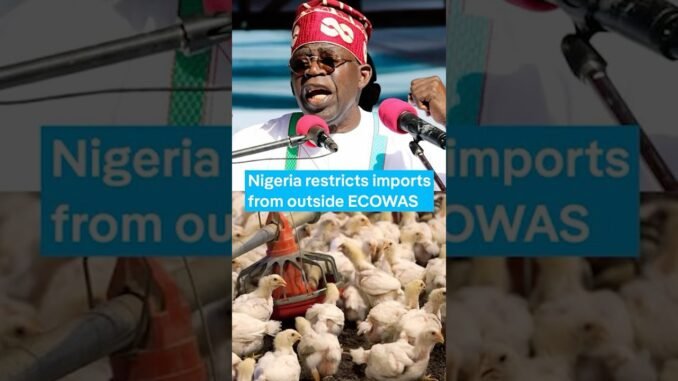

The Federal Government of Nigeria has taken a bold step in reshaping the nation’s trade policy by imposing fresh import restrictions on several key commodities. In a move that has sent ripples across business circles, Abuja has banned the importation of cement, poultry foods, and pharmaceutical products from countries outside the Economic Community of West African States (ECOWAS).
This directive, which forms part of the government’s 2026 fiscal policy framework, represents a significant shift in Nigeria’s economic strategy and signals a renewed commitment to regional integration and local industry protection.
What Does This Ban Cover?
The new import restrictions specifically target three critical sectors:
1. Cement: One of Nigeria’s most essential construction materials, cement importation will now be limited to ECOWAS member states only. This comes despite Nigeria being Africa’s largest cement producer, with major players like Dangote Cement and BUA Cement dominating the market.
2. Poultry Feed: The livestock and poultry industry, which employs millions of Nigerians, will see feed imports restricted to regional sources. This sector has long struggled with the high cost of animal feed, which accounts for up to 70% of poultry production costs.
3. Pharmaceutical Products: Perhaps the most sensitive of the three, pharmaceutical imports will now be sourced exclusively from within the ECOWAS region, raising questions about drug availability and pricing in Nigeria’s healthcare system.
Why Is the FG Taking This Action?
The Federal Government’s decision appears driven by several interconnected objectives:
Promoting Regional Trade Integration
By restricting imports to ECOWAS countries, the government aims to strengthen economic ties within West Africa. This aligns with the broader vision of the African Continental Free Trade Area (AfCFTA) and ECOWAS protocols that encourage intra-regional commerce.
Protecting Local Industries
Nigeria has been battling with the influx of cheap imports that undermine local manufacturers. This policy could provide breathing space for Nigerian producers to compete more effectively, potentially creating jobs and boosting industrial capacity.
Conserving Foreign Exchange
With Nigeria’s foreign exchange challenges persisting, limiting imports from outside the region could help preserve the country’s dollar reserves. ECOWAS trade settlements can potentially be conducted in local currencies or through regional payment systems.
Addressing Trade Imbalances
Nigeria has consistently recorded trade deficits with major economies outside Africa. This policy shift may be an attempt to redirect trade flows and reduce dependency on distant suppliers.
What Does This Mean for Ordinary Nigerians?
For Consumers
The immediate concern for many Nigerians will be the potential impact on prices. If ECOWAS suppliers cannot match the price competitiveness or quality of Asian, European, or American alternatives, consumers may face higher costs for construction, poultry products, and medications.
For Businesses
Companies that have established supply chains with importers from China, India, Europe, and other non-ECOWAS regions will need to urgently restructure their operations. This transition period could create disruptions and additional costs.
For Farmers and Manufacturers
Nigerian poultry farmers and pharmaceutical manufacturers could benefit from reduced competition, but only if local production capacity can meet demand. Otherwise, shortages may emerge.
Challenges and Concerns
While the policy intention may be noble, several challenges loom large:
Production Capacity: Can ECOWAS countries, including Nigeria, produce enough cement, poultry feed, and pharmaceuticals to meet regional demand?
Quality Standards: Will products from regional sources meet the quality expectations that consumers have become accustomed to?
Pricing: Without the competitive pressure from global suppliers, will regional producers maintain reasonable prices?
Implementation: How will the government enforce these restrictions at Nigeria’s numerous porous borders?
Retaliation: Could this trigger trade disputes or retaliatory measures from affected countries?
The Road Ahead
As Nigeria moves to implement these new import restrictions, stakeholders across affected sectors will be watching closely. The success of this policy will depend heavily on the government’s ability to:
– Ensure adequate local and regional production capacity
– Maintain quality standards across all restricted product categories
– Prevent smuggling and policy circumvention
– Support businesses during the transition period
– Monitor pricing to protect consumers from exploitation
This development is yet another indication that Nigeria is willing to deploy trade policy as a tool for economic transformation. Whether this gamble pays off will become clearer in the months ahead as the 2026 fiscal year approaches.
For now, importers, manufacturers, and consumers must prepare for a new trade reality—one that looks inward to West Africa rather than outward to the global market.
What are your thoughts on this new import restriction policy? Will it strengthen Nigerian industries or create more problems? Share your views in the comments below.
For more information, check buzzUp9ja
Be the first to comment