
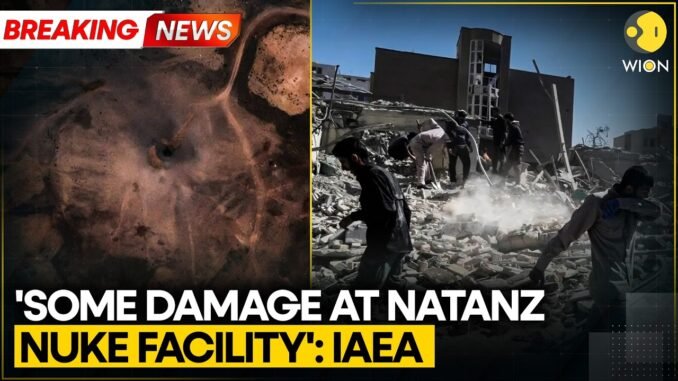

Summary: The International Atomic Energy Agency confirms damage to Iran’s Natanz nuclear site following military operations, raising concerns about regional stability and nuclear safety.
—
The United Nations nuclear watchdog has officially confirmed that Iran’s crucial Natanz nuclear facility suffered damage in recent military strikes, marking a significant escalation in Middle Eastern tensions.
The International Atomic Energy Agency (IAEA) verified the damage after carefully reviewing fresh satellite imagery of the Natanz Fuel Enrichment Plant. The assessment revealed that the facility’s entrance buildings sustained physical damage, making this the first official confirmation of direct impact on Iran’s nuclear infrastructure.
What Was Damaged?
According to satellite images analyzed by American media outlets and spatial intelligence firm Vantor, the strikes affected:
– A large warehouse at the facility
– Two smaller two-story structures
– Entrance buildings to the complex
However, the IAEA has assured the international community that there were no radiological consequences from the attack. The agency emphasized that the core operational areas of the facility remained intact, with no additional damage detected in critical zones.
The Natanz Facility: A Strategic Asset
For those unfamiliar with Iran’s nuclear program, the Natanz facility represents one of the country’s most sensitive and heavily protected nuclear installations. The complex is a fortress-like structure comprising:
– Six above-ground buildings
– Three underground structures
– Capacity to house up to 50,000 centrifuges in two of the underground facilities (according to the Nuclear Threat Initiative)
The underground components make the facility particularly difficult to target, which explains why much of the damage appears concentrated on surface structures.
A Swift Reversal
Interestingly, just one day before confirming the damage, IAEA Director-General Rafael Grossi had stated there was “no indication” that nuclear installations had been struck. The change in assessment came after more detailed satellite imagery became available for review.
What This Means for Regional Stability
This development adds a dangerous new dimension to the already volatile situation in the Middle East. Nuclear facilities, even when damage is limited to non-critical areas, represent red lines for many nations.
For Nigeria and other nations watching from afar, the implications are clear: any military action involving nuclear sites carries enormous risks, not just for the immediate region but for global security and economic stability.
The international community, including African nations that rely on Middle Eastern oil and maintain diplomatic relations with both Western powers and Iran, will be monitoring developments closely.
The Bigger Picture
While the IAEA’s confirmation that no radiological material was released offers some relief, the fact that a nuclear facility was targeted at all raises serious questions about escalation and the potential for miscalculation in future operations.
As global observers continue to track the situation, the hope remains that diplomatic channels can help de-escalate tensions before the conflict spirals further out of control.
—
visit buzzUp9ja for more updates
Be the first to comment